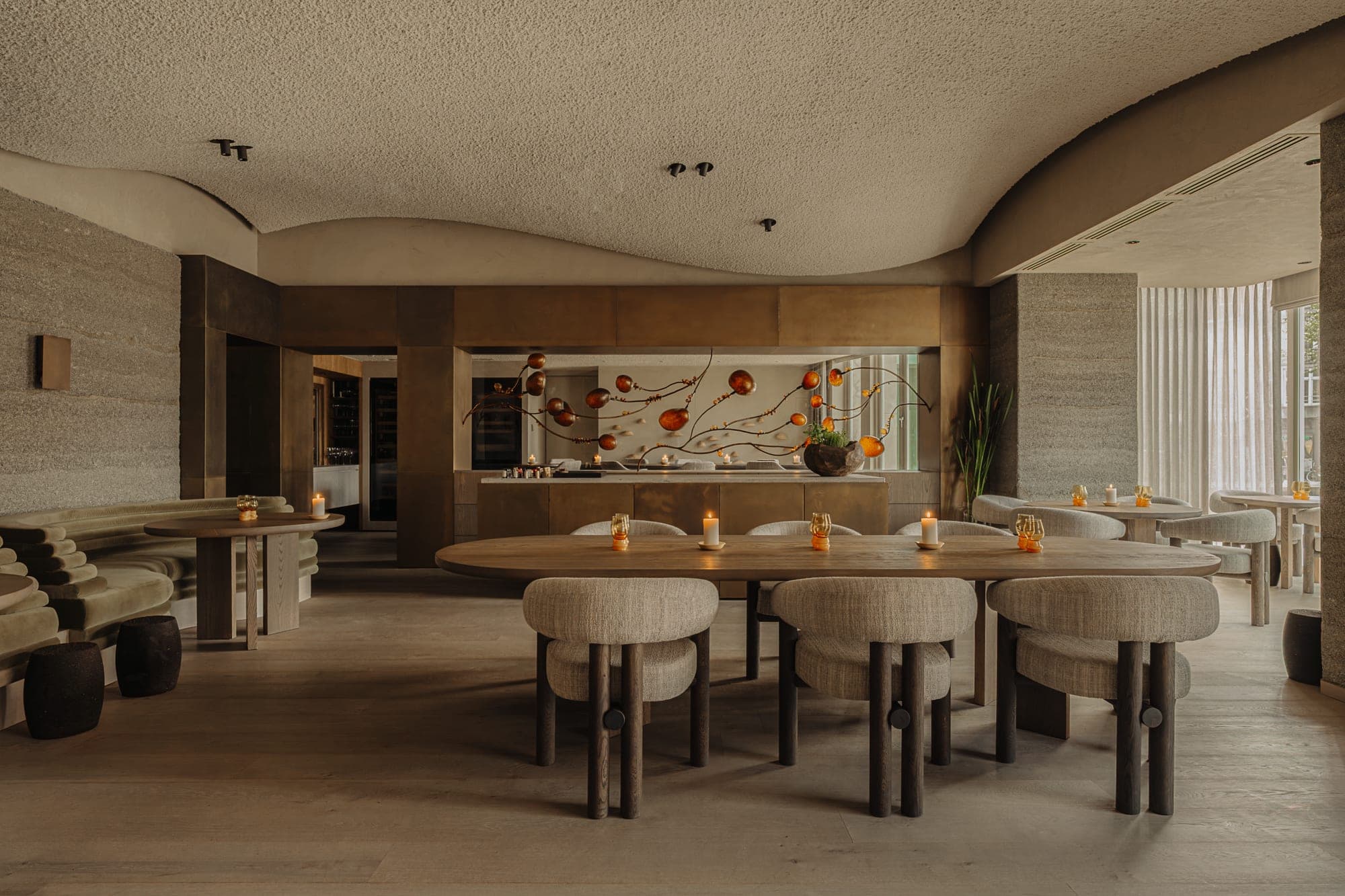
Foto: Restaurant Flore
№ 01Binnenamstel · Modern Dutch · €€€€9.3
Het sterkste bewijs van Amsterdam dat koken op tweesterrenniveau prima om planten kan draaien.
Het diner begint in de keuken, waar het team van Bas van Kranen je een snack in handen drukt plus een korte, oprecht interessante uitleg over de biodynamische boerderijen achter het menu. Daarna word je naar een ruimte van licht hout met elf tafels in De L'Europe gebracht, begin 2026 van vloer tot plafond verbouwd, en neemt het botanische proefmenu het over: nergens zuivel, groenten die gerijpt en gefermenteerd worden alsof het eiwitten zijn, en een gang met knolselderij die de meeste biefstukken opzij duwt. Het volledig plantaardige menu is hier niet de verontschuldigende variant maar de constante, het hele jaar door. Twee Michelinsterren plus de groene, en ongebruikelijk voor dat niveau: het tempo zit erin en het personeel heeft humor. Het alcoholvrije fermentatiearrangement is op zichzelf al serieus vakwerk. Weken van tevoren reserveren; de portiers doen alsof je er thuishoort.
Bestel · Kies het alcoholvrije fermentatiearrangement boven de wijn; daar laat de keuken pas echt zien wat ze kan.
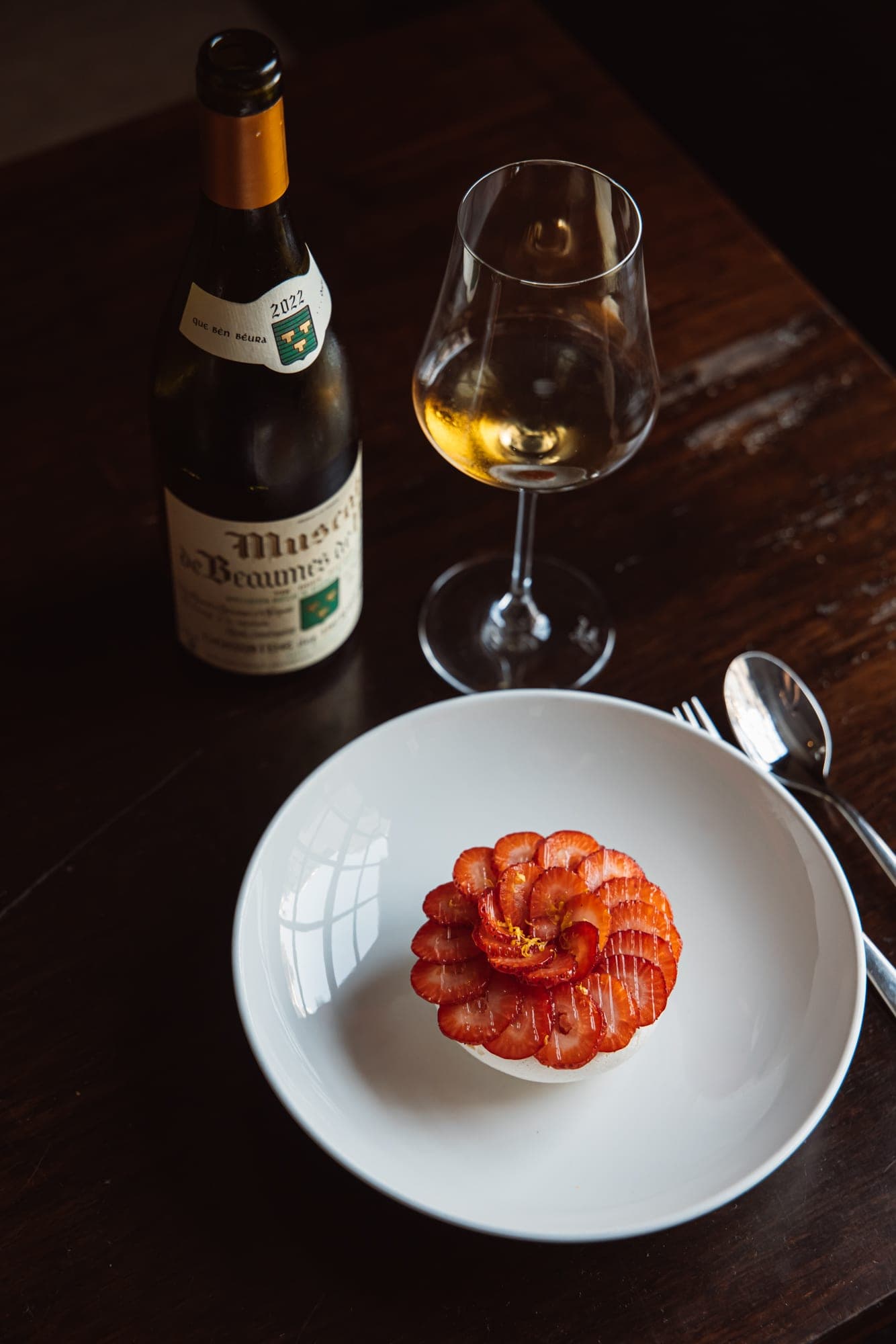
Foto: Zoldering
№ 02Utrechtsestraat · French · €€€9.0
Een Michelinster vermomd als bruin café, met 800 flessen op de wijnkaart.
Opgericht door een sommelier van Ciel Bleu, een chef met De Librije op zijn cv en twee compagnons die verderop in de straat wijnwinkel Lof runnen: Zoldering is wat je krijgt als wijnmensen een restaurant bouwen in plaats van andersom. Het voelt er als een oud Amsterdams café, donker hout, gedempt licht, mensen die hardop lachen, maar wat op tafel komt is Frans op sterrenniveau met het bovenste knoopje los: een pavlova dakpansgewijs belegd met aardbeien en aan tafel overgoten met Muscat de Beaumes-de-Venise, tarbot in een schuim van Hollandse garnalen, een taartje dat aan tafel in karamel wordt gedrenkt. De kaart telt ruim 800 etiketten, van eerlijk voor twintig euro tot onzinnig kostbaar iconenwerk, en drie sommeliers sluiten graag aan bij elk budget. Maandag tot en met zaterdag open tot middernacht, wat Zoldering op de Utrechtsestraat zowel het slimste diner als de beste laatste halte maakt.
Bestel · Geef je over aan het wijnarrangement, daar is de hele zaak voor bedacht, en houd ruimte voor de pavlova.
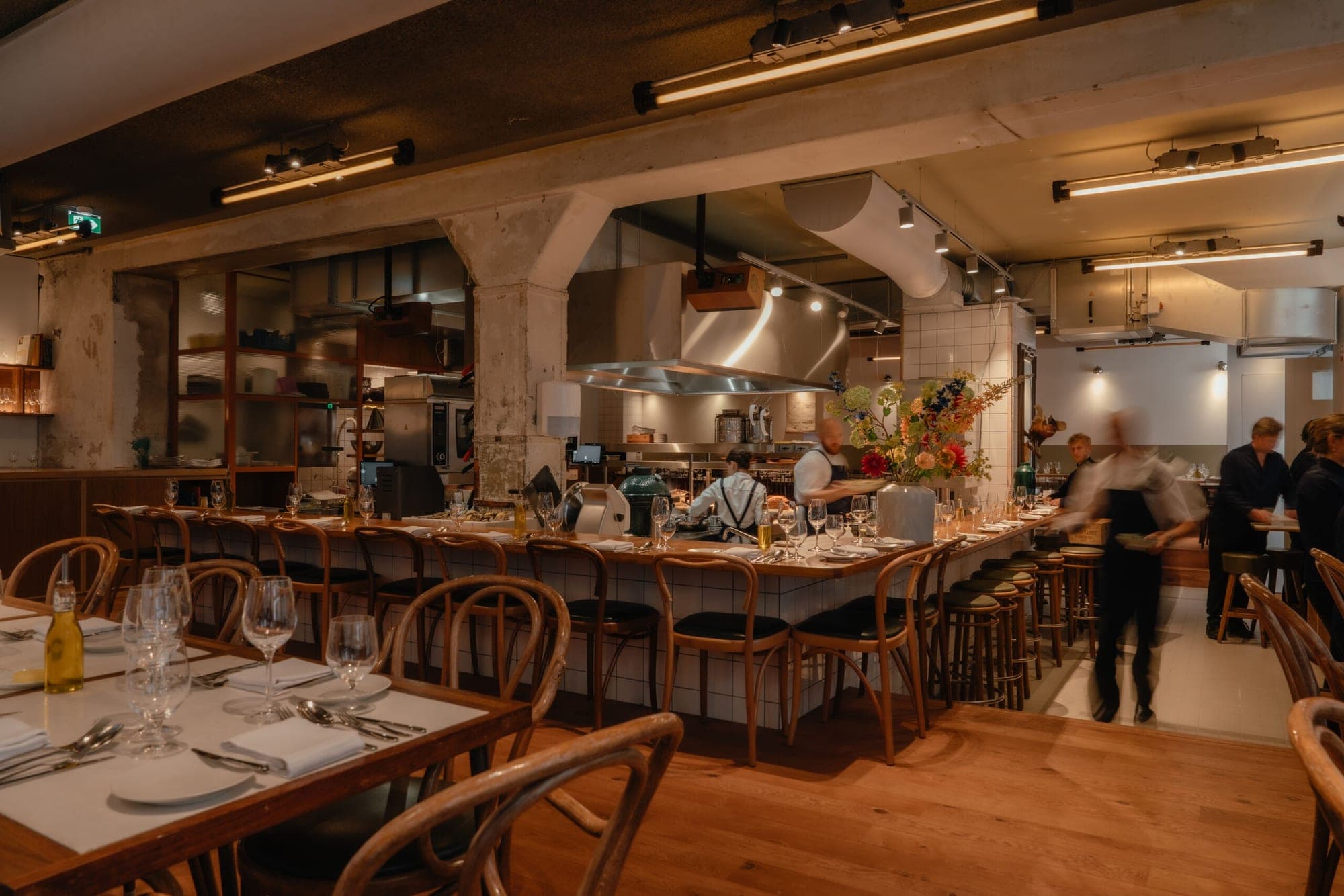
Foto: Kaagman & Kortekaas / Chantal Arnts
№ 03Nieuwendijk · Dutch-French bistro · €€€8.8
Twee chefs die duif, orgaanvlees en eigen charcuterie beter bereiden dan wie ook in de binnenstad.
Giel Kaagman en Bram Kortekaas koken het soort Frans-Hollands eten waar de meeste keukens hun vingers niet aan durven branden: wilde vogels, zwezerik, terrines en zelf gepekelde charcuterie, met sauzen met een ruggengraat. Het decor is een kleine, warme ruimte aan de Sint Nicolaasstraat, een sjofel straatje achter de Nieuwendijk waar je normaal met grote passen doorheen loopt, en aan de pass staat vrijwel altijd een van de twee chefs zelf: je ziet dus meteen wie er verantwoordelijk is voor je diner. De kaart draait mee met de seizoenen, duif met biet in de herfst, haring en asperges zodra de kalender het toelaat, en brood met boter waar je gerust je eetlust voor mag verpesten. De recensenten van Volkskrant en Parool spinnen er al jaren over, en de reserveringsagenda loopt navenant vol. Alleen diner, dinsdag tot en met zaterdag vanaf 18:00 uur. Boek vooruit en vertrouw de chefs.
Bestel · Begin met de huisgemaakte charcuterie, en neem de duif zodra die op de kaart staat.
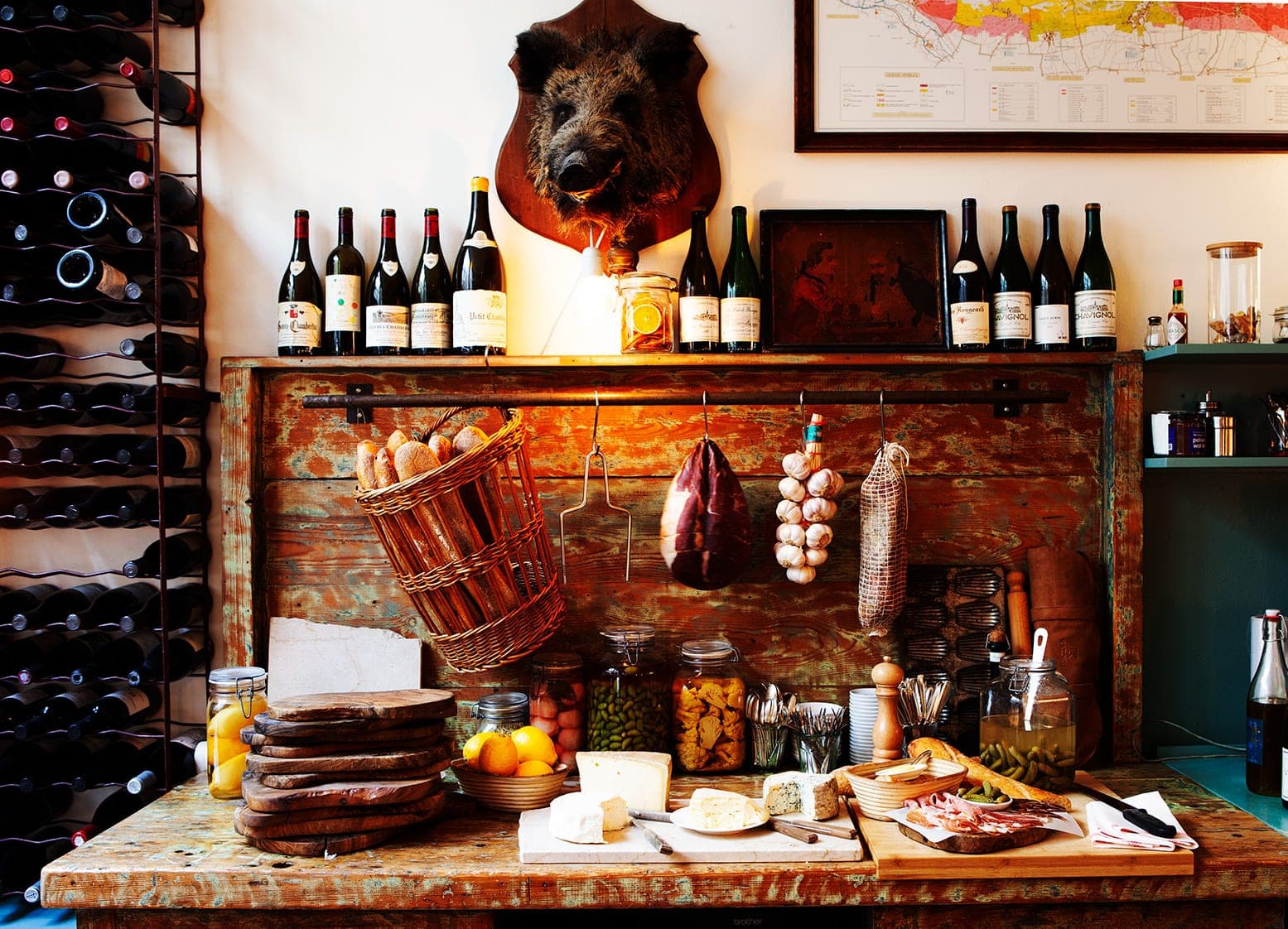
Foto: Café de Klepel
№ 04Negen Straatjes · French bistro · €€€8.6
Wijncafé met alleen Frankrijk op de kaart, waar het dagmenu moeiteloos meekomt met 300 flessen.
Een bruin café dat ongemerkt uitgroeide tot een van de beste Franse bistro's van de stad. De afspraak: een dagelijks wisselend menu van drie of vier gangen (€54.50 of €64.50), gekookt van wat er die ochtend binnenkwam, en een wijnkaart die Frankrijk is of niets, ruim 300 flessen op voorraad, per avond zo'n 25 per glas, voortdurend wisselend. Binnen: donker hout, kaarslicht en geroezemoes; tafels gaan tot maximaal acht personen, dus laat het vrijgezellenfeest thuis. Geen veganistisch menu, geen excuses. Geen tafel te krijgen? Loop vroeg of laat binnen voor de grignoterkaart: een klein bordje, een glas chenin, klaar. Reserveren kan twee maanden vooruit via de widget op de site, en de buurt doet dat massaal, want iedereen op de Prinsenstraat weet precies wat dit voor zaak is.
Bestel · Neem de kaasgang in plaats van het dessert; die is uitgekozen om de wijnkaart te laten schitteren.
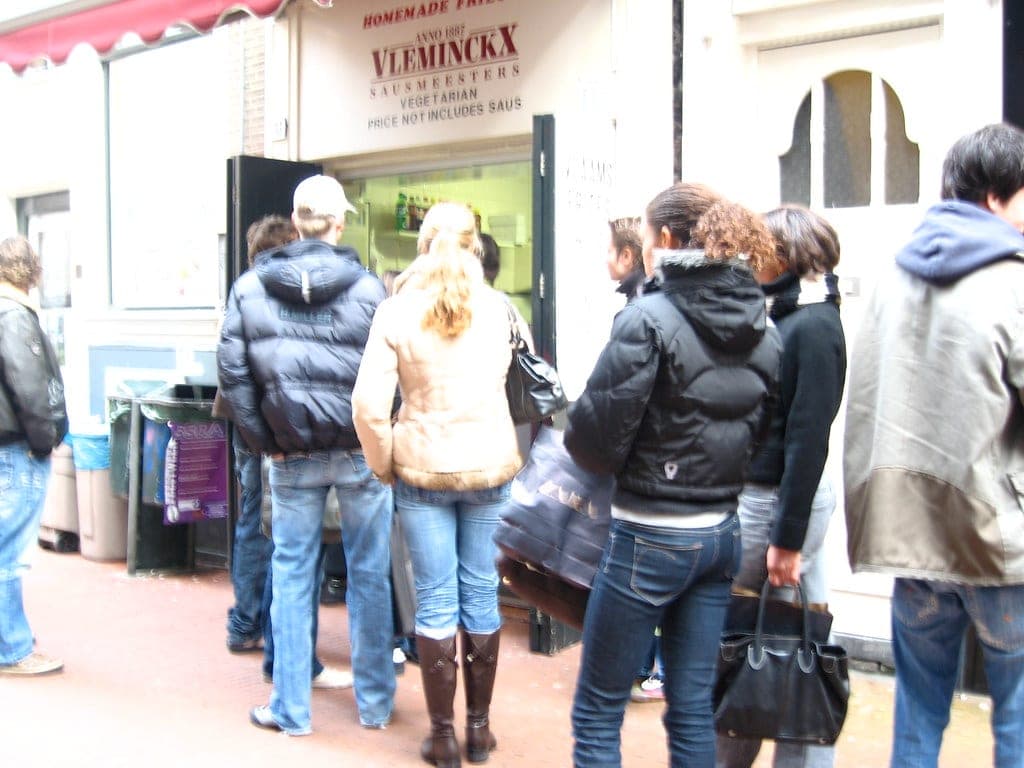
Foto: Salim Virji (Flickr, CC BY-SA)
№ 05Spui · Fries / Flemish friteshuis · €8.5
Het frietloket van Amsterdam sinds 1957; de rij schuift sneller op dan jij een saus kiest.
De rij staat er al voordat de luiken helemaal open zijn, en eigenlijk is die sinds 1957 nooit meer weggegaan. Vleminckx is een gat in de muur aan de Voetboogstraat dat precies één ding doet: echte Vlaamse friet, dik gesneden, twee keer gebakken, gezouten door iemand die het meent. De kaart is een muur met een stuk of 25 sauzen en het juiste antwoord is oorlog, een glorieuze bende van mayo, satésaus en rauwe ui waarna netjes eten je nooit meer smaakt. Niemand komt hier voor comfort. Je schuifelt naar voren tussen studenten, marktkooplui en af en toe een chef in zijn pauze, bestelt in tien seconden en eet staand in de steeg met een piepklein plastic vorkje. De friet blijft knapperig tot op de bodem van het puntzakje, en dat is de hele test. Reken op tien minuten doordeweeks, een halfuur op zaterdag, en nul spijt.
Bestel · Friet medium, oorlog, dubbel ui
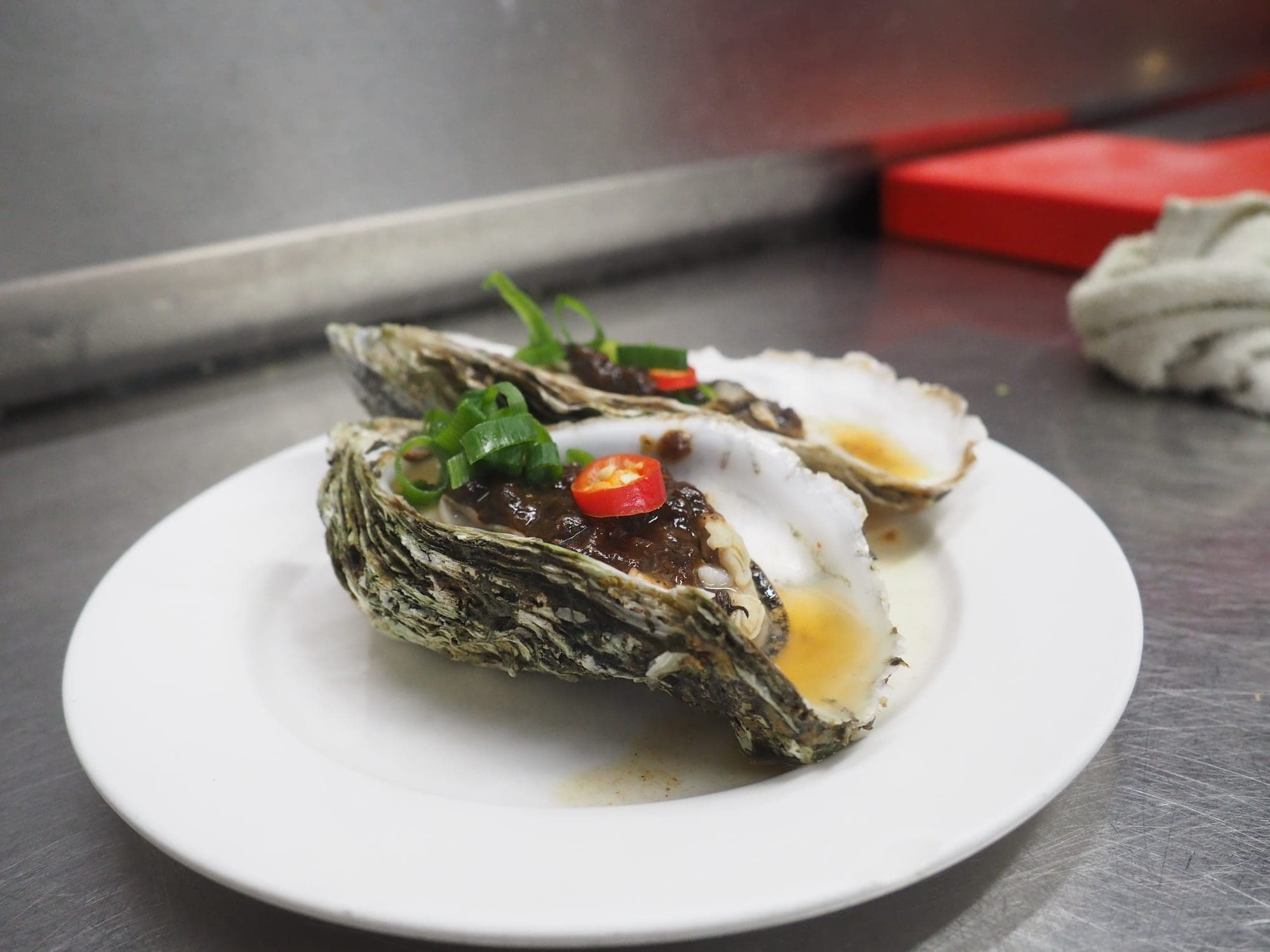
Foto: Nam Kee
№ 06Zeedijk / Chinatown · Cantonese · €8.4
Gestoomde oesters in zwartebonensaus, beroemd sinds 1981; aansluiten en eten.
De gestoomde oesters met zwartebonensaus zijn de bestelling: glibberig, zilt, en beroemd genoeg om een roman en een film (De Oesters van Nam Kee) naar zich vernoemd te krijgen. Verder: char siu die glanst in de etalage, geroosterde eend op rijst, en wontonsoep die zo'n twee minuten na het bestellen al voor je neus staat. De oervestiging op de Zeedijk draait sinds 1981 en dat is eraan te zien: fel licht, kale tafels, personeel dat doorbeent en niet aan koetjes en kalfjes doet. Reserveren kan hier niet; geef je naam op en maak een blokje om, of kom op een dood uur. Het is goedkoop, het is snel, en het is het anker van het kleine Chinatown van Amsterdam. Is de rij te grimmig, dan neemt het filiaal om de hoek aan de Geldersekade wel reserveringen aan, en schuift daar zonder blikken of blozen grote familietafels aan.
Bestel · Begin met de gestoomde oesters in zwartebonensaus, daarna geroosterde eend op rijst.
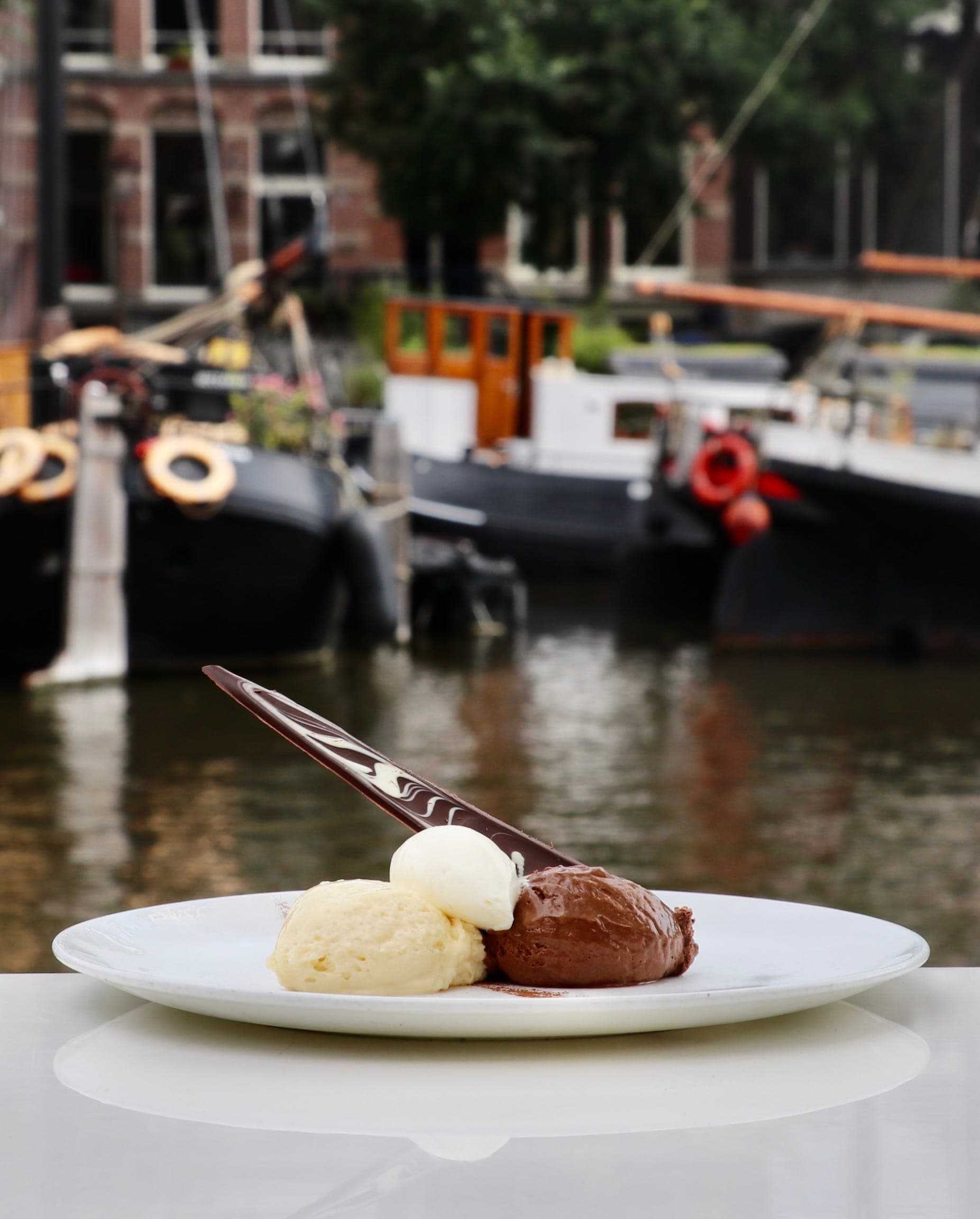
Foto: Hemelse Modder
№ 07Nieuwmarkt · Modern Dutch · €€8.3
Kookt al ruim dertig jaar voor de buurt en rekent nog altijd af alsof dat iets betekent.
Aan het stille stuk van de Oude Waal, waar de Montelbaanstoren aan de overkant zijn ansichtkaartwerk doet, kookt Hemelse Modder al voor deze hoek van de Nieuwmarkt sinds lang voordat iemand het woord 'seizoensgebonden' in de mond nam. De chocolademousse waaraan de zaak zijn naam dankt sluit nog steeds het menu af, en dat moet je vooral zo laten. Daartussen wordt gekookt met een Franse basis en een Amsterdams karakter: schol met Hollandse garnalen, een taartje van gekarameliseerde Cevennes-ui, in drie tot vijf gangen die samen ruim onder de prijs blijven van wat elders aan de grachten één gang kost. Vegetariërs krijgen een volwaardig eigen menu, geen schouderophalen. Het is er sober op de beste Hollands-protestantse manier, en het terras aan de voorkant is op een juliavond een van de rustigste plekken aan de gracht die het Centrum te bieden heeft. Reserveer hier voor ouders die je oprecht graag ziet.
Bestel · Sluit af met de hemelse modder zelf, de mousse van pure en witte chocolade waaraan de zaak zijn naam dankt.
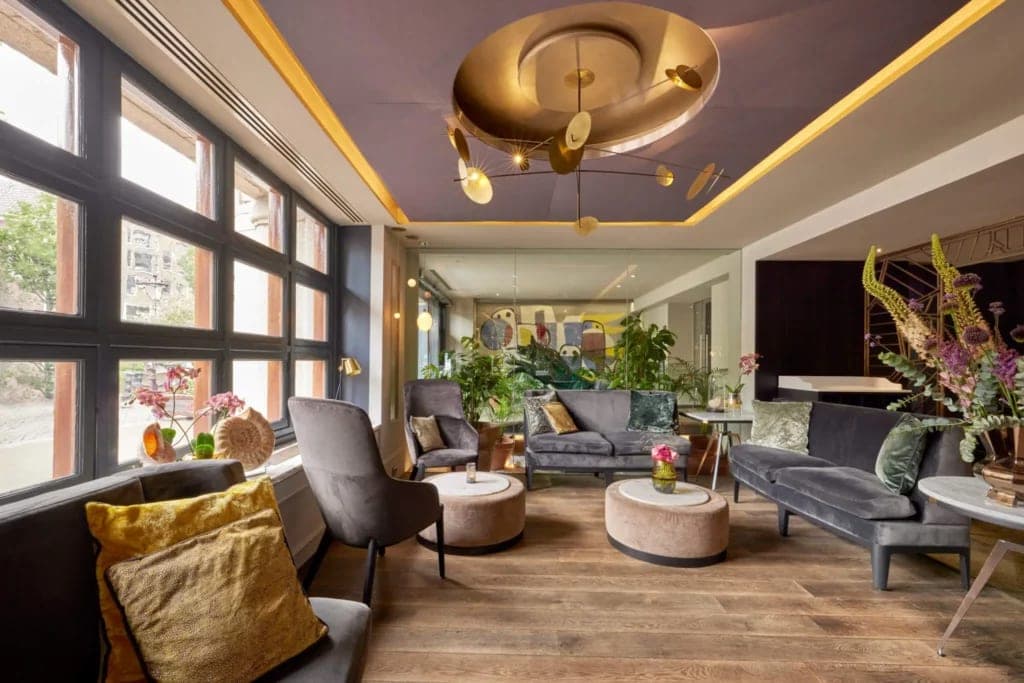
Foto: Restaurant Bridges / Michael Graste
№ 08Oudezijds · Seafood · €€€€8.3
Fine dining met vis voorop, achter de muurschildering van Karel Appel in The Grand.
Het huisrestaurant van The Grand schuilt achter de muurschildering die Karel Appel in 1949 maakte voor de kantine van het gebouw, toen dit nog het stadhuis was, naar verluidt in ruil voor maaltijden. Toepasselijk, want Bridges drijft nog steeds op die ruil van eten tegen kunst: chef Raoul Meuwese zet Franse techniek op Noordzeevis, denk langoustine met een aangescherpte beurre blanc, tong van de graat, en een kaviaarservice voor verjaardagen met een dertiende maand. De ruimte is kalm, roomkleurig en volwassen, bemand door mensen die zichtbaar plezier in hun vak hebben, en het terras op de binnenplaats is de rustigste vierkante meter binnen tweehonderd meter van de Wallen. De weekendlunch is de slimme zet: dezelfde keuken, een vriendelijker rekening, daglicht op de binnenplaats.
Bestel · Begin met de oesters, daarna de Noordzeetong. Lunch is er vrijdag tot en met zondag en dat is de voordelige route; dinsdag tot en met donderdag is de deur dicht, dus mik op een lang weekend.
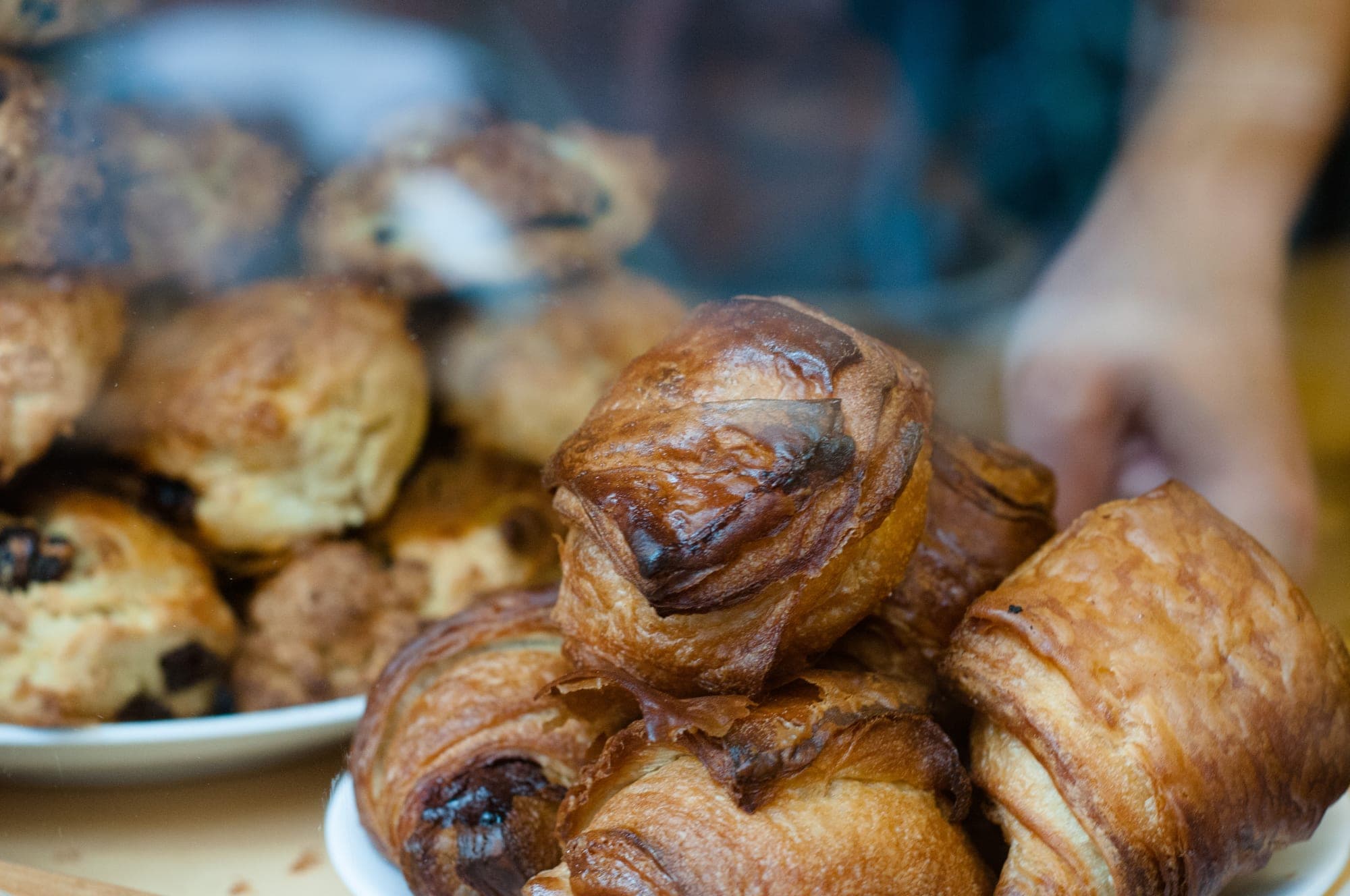
Foto: Gebroeders Niemeijer
№ 09Nieuwendijk · French bakery, breakfast · €€8.3
Een echt Frans ontbijt onder een origineel art-decoplafond, vanaf 8:15 geserveerd terwijl de steenoven achter de toonbank gewoon doordraait.
Issa Niemeijer begon deze bakkerij in 2008 samen met zijn broer Marco en runt hem sinds 2011 alleen, en het is nog altijd het serieuste brood van het centrum: alles met de hand gevormd, gebakken in een grote oven met stenen vloer, geen toevoegingen en geen halffabricaten. De ruimte is de reden om hier op een dinsdag om half negen iemand mee naartoe te nemen. Een hoog historisch interieur met een origineel art-decoplafond en zicht zo de open bakkerij in, 's ochtends stil, met tafels waar je je papieren over uit kunt spreiden en bediening die niet om je heen blijft hangen. Het petit dejeuner van 9,95 euro levert drie petit pains met boter en marmelade, een croissant of brioche, koffie en verse jus. De extra versie van 12,95 euro doet er Hollandse boerenkaas, gruyere en Italiaanse scharrelham bij. De koffie is Costadoro-espresso uit Turijn, de kaas komt van Fromagerie Kef en de vleeswaren van Lindenhoff en Brandt en Levie. Het enige waar je omheen moet plannen: maandag dicht, en de ontbijtbediening stopt om klokslag twaalf uur. Dat de Nieuwendijk een toeristenstraat met een slechte naam is, maakt de rust binnen alleen maar meer een privévondst.
Bestel · Maandag gesloten. Ontbijt dinsdag tot en met vrijdag 8:15 tot 12:00, lunch vanaf 11:00. Reserveer via de Brigaid-link op hun site als je zeker wilt zitten, anders ben je voor negenen en heb je de zaak voor jezelf.
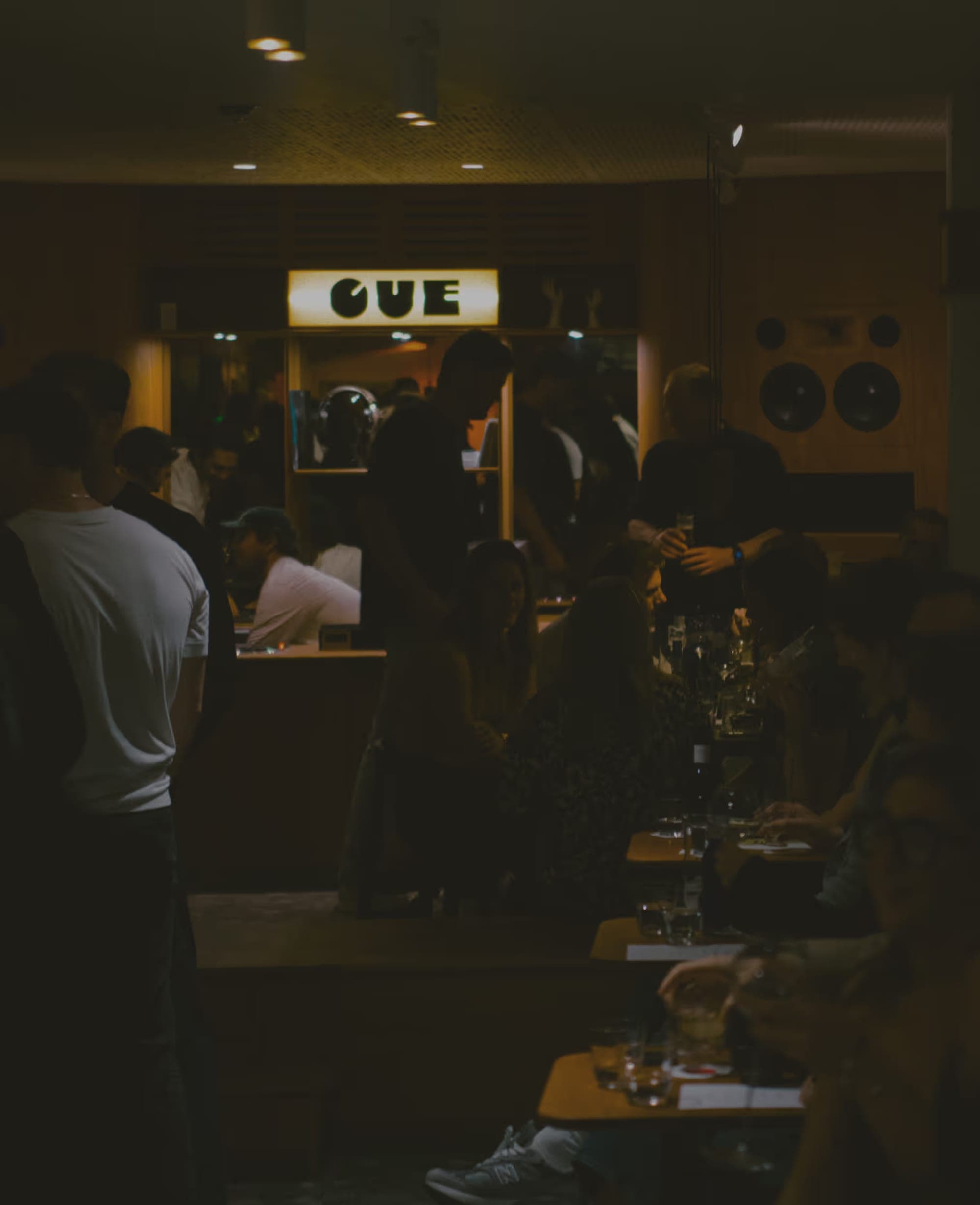
Foto: CUE
№ 10Grachtengordel · Open-fire fine dining · €€€€8.3
Sterrenkoken op houtvuur boven, een vinyl-listening bar in het souterrain, samen één heel goede avond.
CUE is twee ideeën boven op elkaar aan de Utrechtsestraat, en ze werken allebei. Boven kookt George Kataras (ex-Vanderveen, waar hij met sommelier Mo Aous in achttien maanden een ster haalde) alles op hout en kolen: gefermenteerd, gepekeld, gerookt, gerijpt, en dan opgemaakt alsof het geen moeite kostte. De Michelinster van 2026 zegt van wel. De menu's heten Volume 1 en Volume 2, want beneden zit het andere idee: een Japans aandoende listening bar waar elke plaat vinyl is, het geluidssysteem op maat is gebouwd en de dirty martini met miso en zeewierwater komt. Die bar won een internationale cocktailprijs voordat de straat goed en wel doorhad dat hij bestond. De juiste route: boven eten, dan naar beneden zakken voor een slaapmutsje terwijl iemand een jazzplaat opzet die je de rest van de week probeert thuis te brengen. Reserveer het restaurant ruim vooruit; de bar is alleen walk-in, en dat voelt bijna gul.
Bestel · Geen reservering? De bar in het souterrain is walk-in, woensdag tot en met zaterdag, doordeweeks open tot 01:00 en vrijdag en zaterdag tot 02:00, en Kataras' barfood is de goedkoopste route naar sterrenkoken van de stad. Zondag tot en met dinsdag blijft de deur dicht.
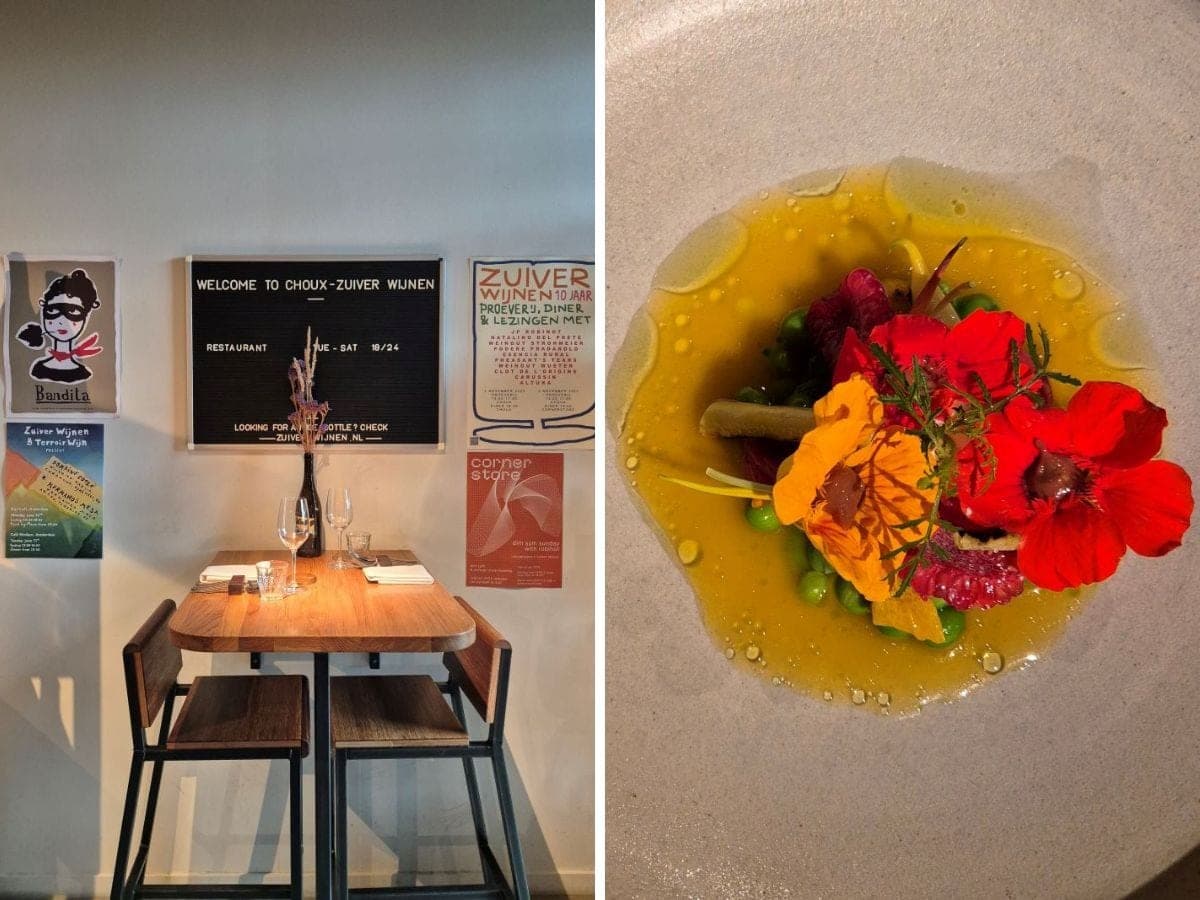
Foto: The Greenlist
№ 11Oosterdok · Vegetable-forward tasting menus, natural wine · €€€8.2
De dieprode oud-fabriek achter Centraal waar groente een Michelinster verdiende en de natuurwijn via de eigen importeur binnenkomt.
Het dieprode fabriekspand aan de kade achter Centraal kookt sinds 2015 in alle rust de halve stad naar huis. Choux begon als popup-jochies met uitgesproken natuurwijnovertuigingen en groeide op tot een Michelinster, in 2025 opgehaald zonder ook maar iets aan het plan te veranderen: negentig procent groente en fruit, tien procent vooral wild en schelpdieren, en alles wordt ergens in het pand gefermenteerd, gepekeld of gerookt, inclusief een eigen lijn condimenten onder de naam 621 Ferments. Merijn van Berlo waakt nog altijd over de keuken, en per bord zitten hier meer ideeën dan bij proeverijen van het dubbele tarief. Vijf gangen kosten 82,50, en het Theatermenu geeft je er drie voor 52,50 als je de tafel om acht uur teruggeeft. De wijn is de andere helft van het verhaal: eigenaar Figo van Onna is in de eerste plaats sommelier, importeert via zusterbedrijf Zuiver Wijnen en runt een paar deuren verderop op nummer 143 een winkel met wijnbar. Zelf zegt hij meer van zijn team te genieten dan van de ster, en na jaren koppig alleen filterkoffie schenken is het espressoapparaat terug, wat je groei mag noemen. Alleen pinnen, en vegetariërs zijn hier de norm in plaats van de uitzondering.
Bestel · Pak het Theatermenu van zes uur: dezelfde keuken, 52,50, tafel tot acht uur. Loop daarna naar de bar van Zuiver Wijnen op De Ruijterkade 143 voor nog een glas. Reserveren per telefoon of mail, geen online widget, en niks boven de acht personen.
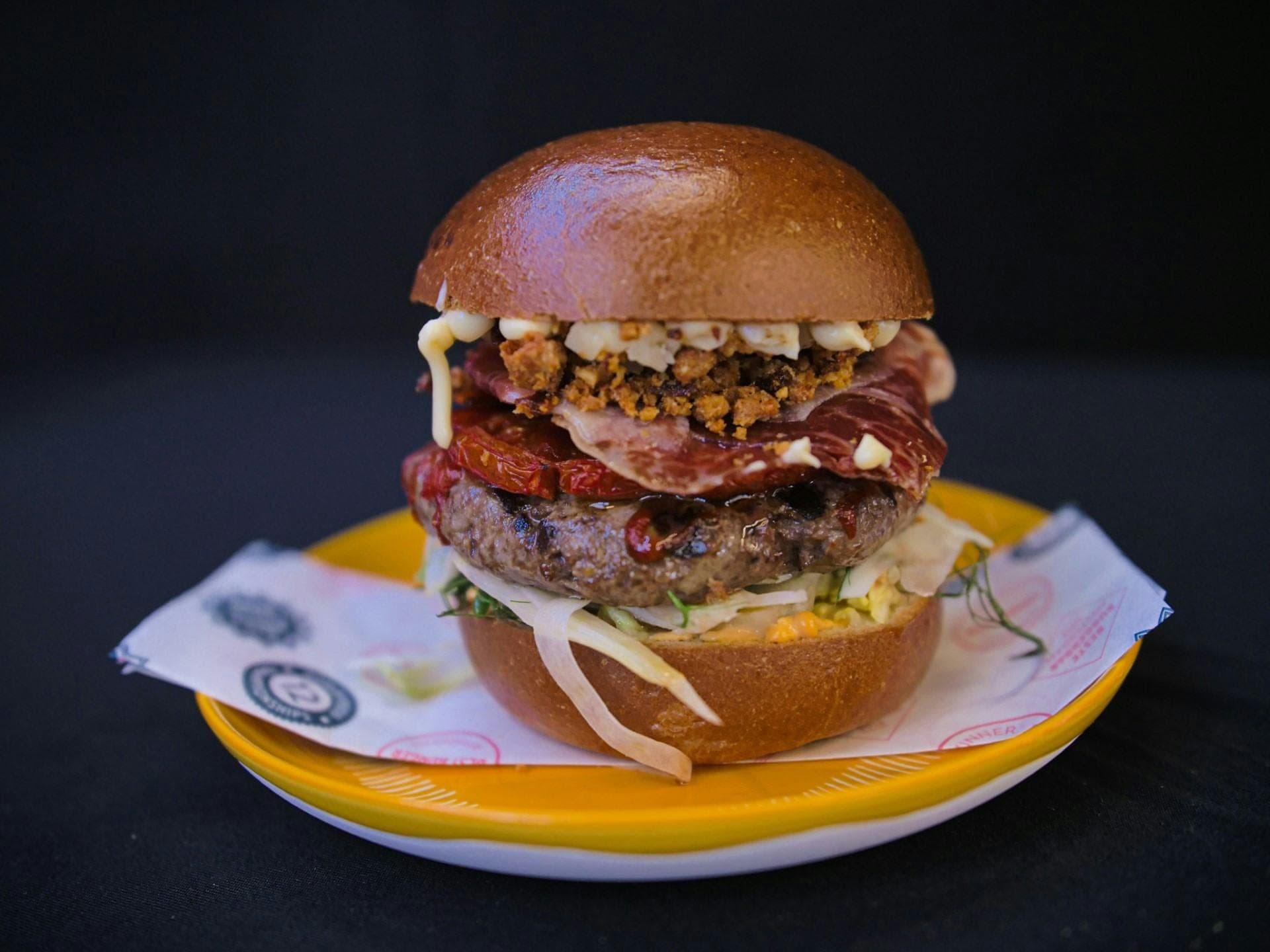
Foto: Ter Marsch & Co, via Misset Horeca
№ 12Grachtengordel · Gourmet burgers · €€€8.2
De burgerbar van hotel NH Collection bij de Bloemenmarkt, met een titel die niet verzonnen is: bekroond tot lekkerste hamburger van Nederland.
Ter Marsch & Co opende zijn eerste boetiekburgerrestaurant in 2014 in Rotterdam en verzamelde in een decennium precies de landelijke titels waar de meeste burgertenten alleen in hun eigen marketing mee schermen. De Amsterdamse vestiging zit in hotel NH Collection FlowerMarket, op de hoek van Singel en Vijzelstraat, vlak bij de drijvende bloemenmarkt, dagelijks open van twaalf tot tien uur 's avonds en zonder reservering toegankelijk voor kleine groepen. De kaart splitst zich in Classic Hamburgers en Signature Hamburgers, en die laatste categorie heeft de trofeeën om het te bewijzen: La Fiesta de Carne, gebouwd op Spaanse Black Angus met een manchego-kaascustard, 24 maanden gerijpte serranoham en een chorizo-notenkruimel, won de NK Lekkerste Burger 2024, het Nederlandse kampioenschap dat op de Horecava wordt beoordeeld en georganiseerd door Stichting de Lekkerste Wedstrijden. Diezelfde chef, Andy Hoogvliets, won vervolgens NK Loaded Fries 2025 met een Bali Spice Fries-recept. Beide titels zijn echt, gedateerd en na te trekken op de eigen resultatenpagina's van de wedstrijd, geen marketingpraat van het restaurant zelf. Brunch en lunch lopen tot 16:00 door, naast de volledige burgerkaart, en een serieuze cocktailkaart maakt de frites compleet.
Bestel · Dagelijks open van 12:00-22:00, inlopen kan voor kleine groepen (mail vooraf bij gezelschappen van 8 of meer); brunch- en lunchgerechten lopen tot 16:00 door, naast de burgerkaart.
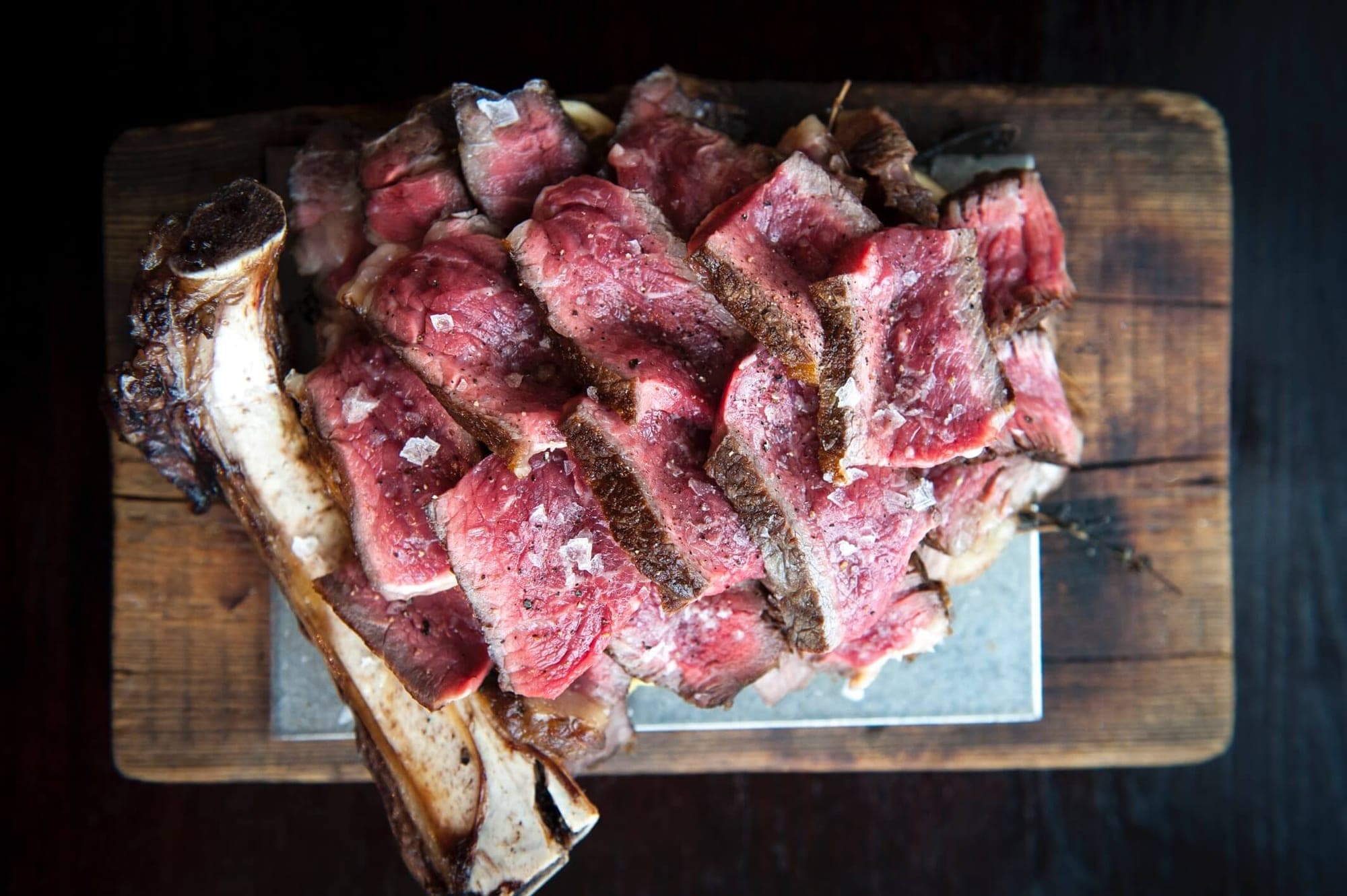
Foto: Gebr. Hartering
№ 13Lastage (Nieuwmarktbuurt) · French, nose-to-tail, charcoal grill · €€€8.1
Paul Hartering kookt sinds 2011 aan de Peperstraat elke dag een ander menu, en Het Parool noemde het ribstuk en de wijnen in 2026 'ongeëvenaard'.
De Limburgse broers Paul en Niek Hartering begonnen in 2011 in een hoekpand aan de Peperstraat. Paul begon bij Van der Valk en kookte daarna onder meer bij Merkelbach. Niek had bij de start bijna geen horeca-ervaring; nu is hij gastheer en kiest hij de wijn, vooral biowijn en natuurwijn. Paul kookt elke dag een ander verrassingsmenu: drie gedeelde voorgerechten, een hoofdgerecht en een dessert, uit te breiden tot zeven gangen. Het kan vegetarisch, en wie geen menu wil, bestelt van een kleine à la carte kaart. Mara Grimm gaf de zaak in april 2026 in Het Parool een 8,5. De broers zijn volgens haar 'hun wilde haren kwijt' en de wijnkaart is 'alleen maar beter geworden'. Gault&Millau geeft 15 van de 20 punten en spreekt van 'uitstekende kwaliteit voor een betaalbare prijs'. Gasten prijzen vooral de bediening, die gerechten en wijn goed uitlegt, en het ribstuk.
Bestel · Reserveer ruim vooruit: Michelin schrijft dat het er altijd vol zit. Boeken gaat via de widget op de site of via 020 421 0699; de zaak is dagelijks open vanaf 18:00.
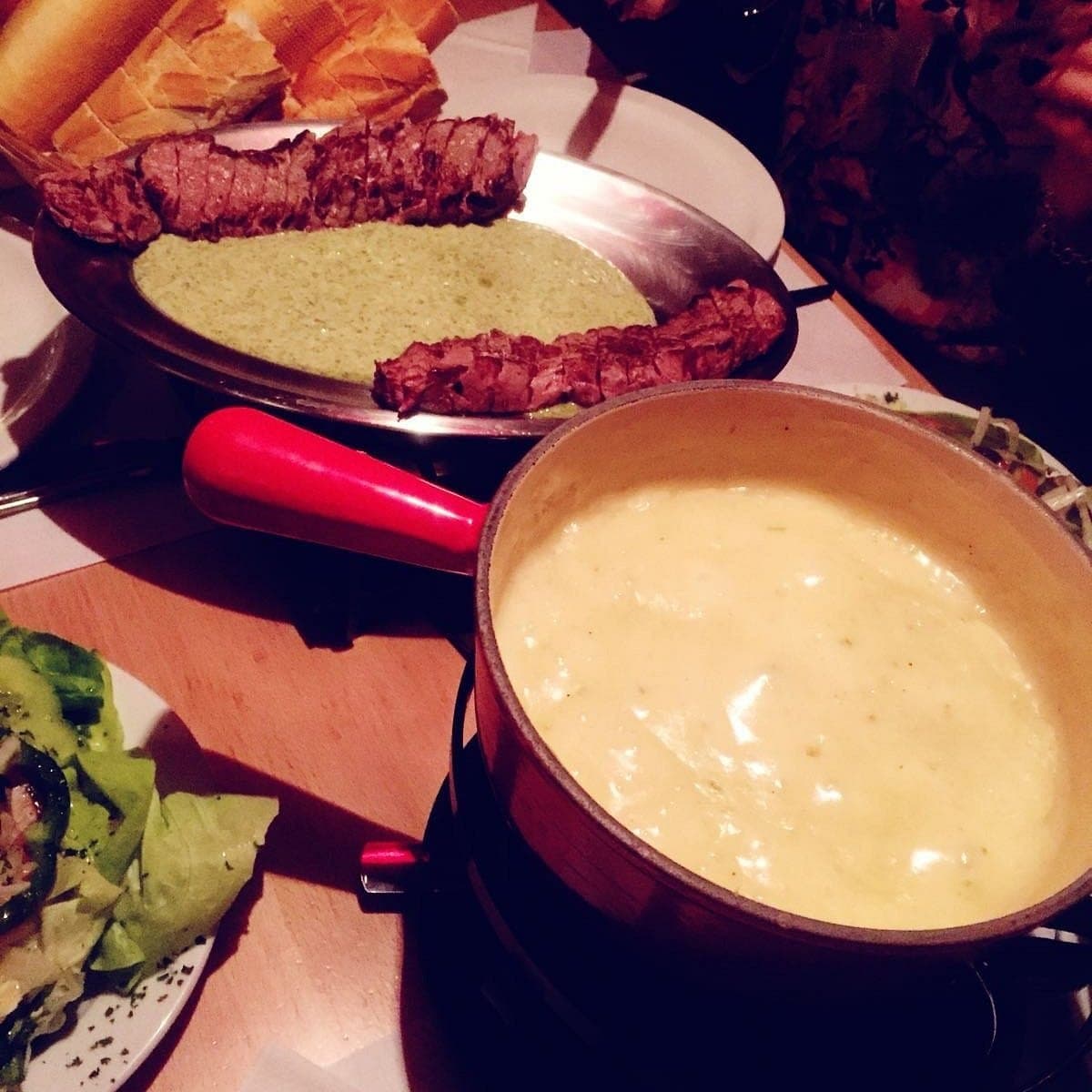
Foto: Café Bern
№ 14Nieuwmarkt · Eetcafé, Swiss fondue · €€8.1
Kaasfondue voor één aan de bar van een bruin café, sinds 1978 onveranderd, reserveren kan alleen telefonisch.
Helmut Winzeler was een Zwitserse kernfysicus die bij CERN werkte voordat hij op 26 augustus 1978 dit donkere cafeetje aan de Nieuwmarkt opende, en de keuken draait sindsdien op zijn recepten met bijna wetenschappelijke precisie. De kaart is een handgeschreven kaartje dat nauwelijks beweegt: kaasfondue voor 24 euro per persoon, een entrecôte Café Bern met salade voor 25, emincé de veau, steak au poivre, spaghetti met vleessaus en een soep van de dag, het enige dat wisselt. Binnen is het precies wat je van een bruin café wilt: hout, weinig licht, een echte bar met krukken, kunst aan de muur die om de paar maanden wisselt. Wat het tot een eetcafé maakt en niet tot een curiositeit, is dat de fondue oprecht goed is, het brood klopt en de Zwitserse wijnen per glas met zorg gekozen zijn. Het Parool zet Bern keer op keer in zijn lijst van beste fondueadressen van de stad, voor het laatst in januari 2026, en de Proefwerk-recensie uit 2017 noemde het een goed café met een goede keuken, geen cultact. Het voorbehoud zit in de logistiek: reserveren kan alleen telefonisch vanaf 15:00, maximaal twaalf personen, en op koude avonden zit het snel vol. Wie alleen komt kan een enkele fondue bestellen, wat zeldzamer is dan het zou moeten zijn.
Bestel · Dagelijks open 16:00 tot 01:00, keuken 18:00 tot 23:00. Bel vanaf 15:00 voor een tafel of pak vroeg een barkruk. Bestel de fondue en de Jemenitische sla, en neem er een Fendant du Valais per glas bij.
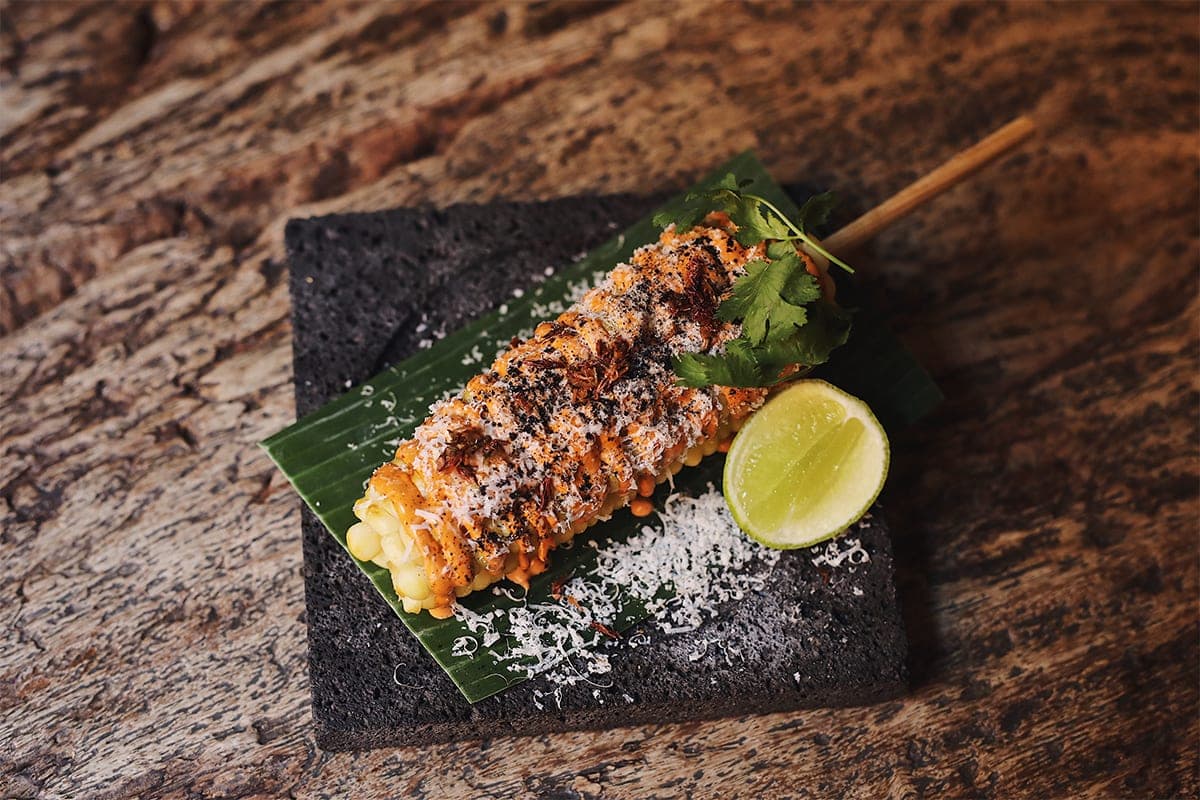
Foto: Oaxaca Amsterdam
№ 15Spuistraat · Oaxacan Mexican, mezcaleria · €€€8.1
Chef Joan Bagur kookte twintig jaar in Mexico voor hij aan de Spuistraat een Oaxacaanse kantine en een mezcaleria met tweeëndertig flessen neerzette.
Voordat Joan Bagur aan de Spuistraat een oude toeristenval overnam, kookte hij ruim twintig jaar in Mexico, en dat merk je aan de details die je nergens anders in de stad tegenkomt: chapulines als het seizoen het toelaat, vijf verse salsa's voor de guacamole die aan tafel wordt klaargemaakt, chicatana-mieren die rechtstreeks uit de velden rond Oaxaca-Stad worden ingevlogen. De keuken splitst zich in een informele streetfood-kant en een volwaardig restaurant dat oploopt tot een proeverijmenu van tien gangen, dus of je nou alleen voor een paar taco's binnenloopt of met een groep het hele menu boekt, je wordt allebei serieus genomen. Achterin zit een echte mezcaleria: tweeëndertig flessen, samengesteld met een mezcal maestro van Destilerías Tlacolula, in een ruimte die aanvoelt als een klassieke Mexicaanse cantina. Het drieluik van oesters, met tonijn, komkommer-limoensorbet en Hermosillo-machaca, is het gerecht om een tafel omheen te plannen. Iberische cochinita pibil en de zwarte molekip zijn de zwaardere gangen voor wie voor het diner blijft. Het hoort bij de Sagardi-groep, wat de gepolijste afwerking verklaart, maar de keuken zelf voelt persoonlijk aan, niet als een keten.
Bestel · Dagelijks open van 12:30-23:00, keuken 12:30-15:00 en 18:00-22:00, mezcaleria tot middernacht; de lunch is de makkelijkste manier om zonder wachttijd aan het proeverijmenu te beginnen.
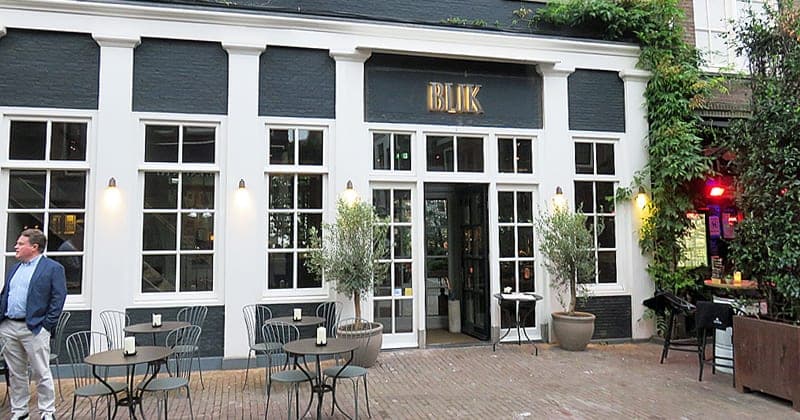
Foto: Blik, via Reguliers.net
№ 16Grachtengordel · French bistro · €€€8.1
Bistrokaart van Jacob Jan Boerma, ooit drie sterren met De Leest, in een achttiende-eeuws koetshuis, met hele kip en tarbot voor twee.
Blik opende in september 2025 in het achttiende-eeuwse koetshuis van Huis de Neufville, waar eerder Lion Noir zat. Eigenaren zijn onder anderen Tijn Verstappen (Pazzi, Pepito), acteur Manuel Broekman en Jacob Jan Boerma, die met De Leest in Vaassen drie Michelinsterren had. Boerma bedacht de kaart. Verstappens inmiddels gesloten restaurant Nonna kreeg van Het Parool een 4. 'Die 4 heeft echt wat in me teweeggebracht', zei hij bij de opening tegen die krant. 'Dat heeft tot Blik geleid.' Als hapje bestel je oesters (vanaf 5 per stuk) of brioche met steak tartaar. Bij de hoofdgerechten staat tournedos (34,50); met z'n tweeën deel je een hele kip (49) of tarbot van 800 gram (69). Het chefsmenu van drie gangen kost 49,50, een fles wijn 37,50 tot 300. Voor 45 tot 70 euro per persoon moet je volgens Verstappen bij zijn zaken een leuke avond kunnen hebben; Blik noemt hij 'wat chiquer'. Gasten roemen de vriendelijke, snelle bediening en de tuin; het eten waarderen ze iets lager.
Bestel · Op zaterdag en zondag is Blik vanaf 12.00 open voor lunch, van dinsdag tot en met vrijdag vanaf 18.00 en op maandag niet. Reserveren kan online of via 06 11 99 91 94, ook per WhatsApp.
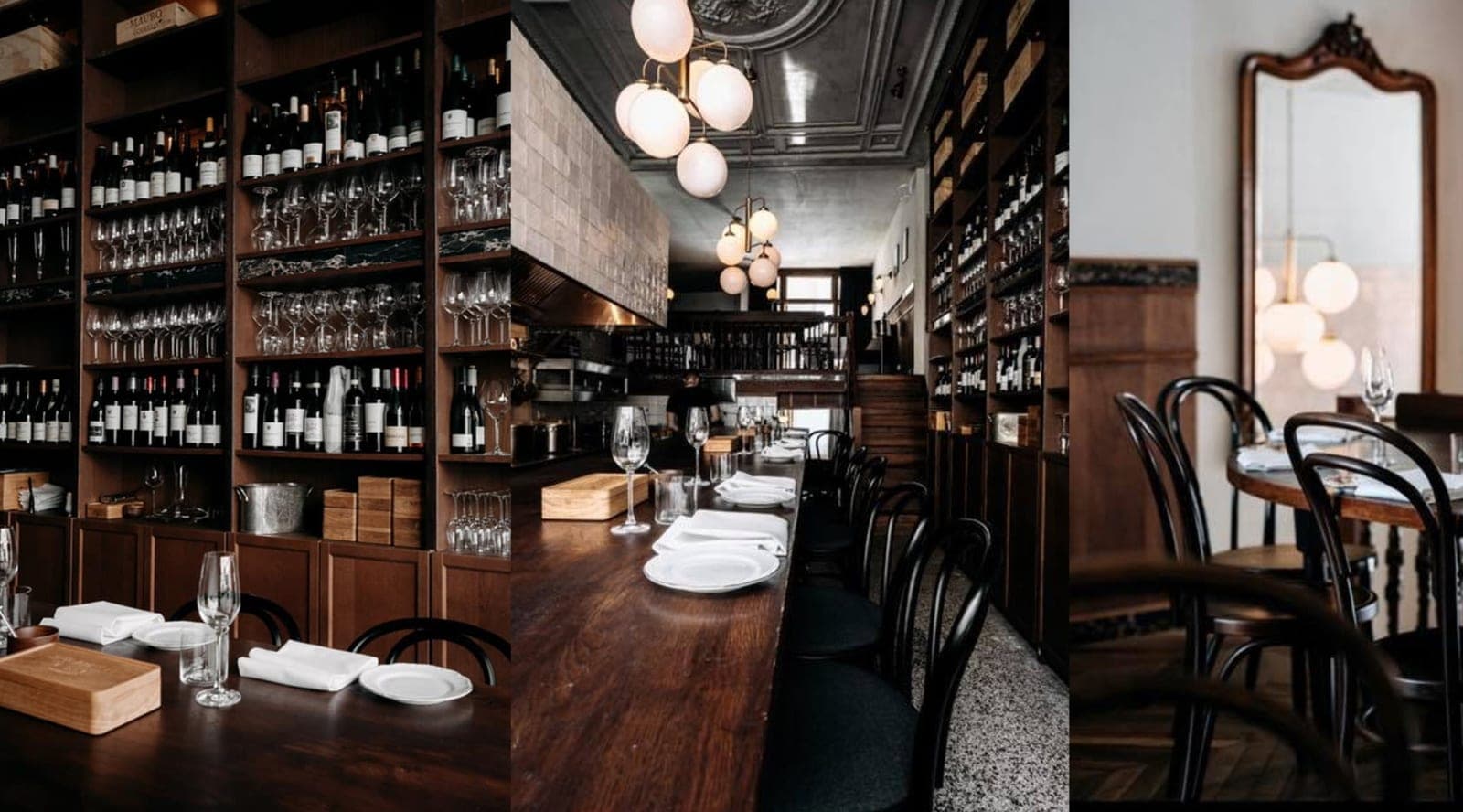
Foto: De Juwelier, via AmsterdamNow
№ 17Utrechtsestraat · Modern French, Michelin-starred · €€€8.1
Eén Michelinster, een nieuwe chef, en dezelfde keuken waaruit Yoran Jacobi en Moriaan Koeleman in 2025 vertrokken om Veneur te beginnen.
Toen Yoran Jacobi en Moriaan Koeleman in 2025 samen met sommelier Bas Hazen vertrokken om aan de Weteringschans hun eigen Veneur te beginnen, bleef er op de Utrechtsestraat een keuken over met een Michelinster sinds 2022 en geen chef om hem te dragen. Eigenaren Richard van Oostenbrugge en Thomas Groot, die met 212 zelf twee sterren op zak hebben, haalden Thomas van Santvoort binnen, die net acht jaar Flicka in Kerkdriel had afgesloten en aan een nieuw hoofdstuk in Amsterdam toe was. Zijn kaart houdt vast aan het idee dat De Juwelier al had: bistrocomfort met sterrenprecisie. Een tartaar van Holsteiner rund met een wilde Wadden-oester en een cracker van zeewier, een tomatensalade waarin dragon het opneemt tegen roomijs van Zaanse mosterd, gerechten die eenvoudig ogen en doordacht smaken. Het interieur is hetzelfde gebleven: wit tegelwerk, donker hout, een bar met zicht op de open keuken, vijfenveertig plekken die op een dinsdag gewoon vol zitten. Het is niet de eerste keer dat deze keuken een chef aflevert die elders opvalt; Jacobi won hier in 2022 de Michelin Young Chef Award voordat hij voor zichzelf begon. Van Santvoort moet nu bewijzen dat het volgende hoofdstuk dezelfde aandacht verdient.
Bestel · Ma-za 12:00-14:15 en 17:30-22:00, zo de hele dag open van 12:00 tot 22:00. De lunch van vijf gangen voor 58 euro is de goedkoopste manier om een menu van Van Santvoort te proeven.
№ 18Zeeheldenbuurt · Modern European · €€€8.1
Kookboekenschrijver Bloeme Burema kreeg hier binnen een jaar twee koksmutsen en houdt de keuken open tot middernacht.
Bloeme Burema schreef kookboeken over bonen en over soep, trok met Gina Verheij rond met Café Soigné, en sinds november 2025 staat dat alles stil op één adres: de Planciusstraat in de Zeeheldenbuurt. Gault&Millau kwam nog voor de eerste verjaardag langs en liet een 13 met twee koksmutsen achter; De Westkrant vertrok licht verliefd. Keuken en bar lopen in elkaar over tot één rustige ruimte, en op de kaart wint verbeelding het van techniekvertoon: een oeuf sambal op shiso, kalfstong met huzarensalade en gerookte eidooier, savooiekool van de barbecue met bruine boter en walnotensaus. Het toetje doet gewoon mee, zie de crêpe brûlée met saffraanijs. Woensdag tot en met zaterdag van vijf tot middernacht, waarmee dit aan deze kant van het station een van de weinige serieuze keukens is waar je laat nog kunt aanschuiven. Alleen pin, en het zit er snel vol.
Bestel · Een van de weinige goede keukens waar je tegen middernacht nog een bord krijgt; reserveer toch, de avonden lopen snel vol. Wo-za 17:00-00:00, alleen pin, geen contant geld.
Foto: Tokoman
№ 19Waterlooplein · Surinamese · €8.0
Het beste broodje pom van Amsterdam, over de toonbank op de markt van het Waterlooplein.
Een Surinaamse toonbank aan de rand van de vlooienmarkt op het Waterlooplein, waar de rij op zaterdagmiddag je alles vertelt wat je moet weten. Het draait om het broodje pom: warme pom, zoetzuur en hartig, kip die urenlang met pomtajerwortel de oven in ging, hoog opgetast op een zacht bolletje, peper op verzoek, zuur van komkommer als je slim bent. Verder zijn er rotischotels, bara's, saotosoep en wokbakken, elke dag vers bereid en geprijsd alsof het afgelopen decennium nooit heeft plaatsgevonden. Zitplekken zijn er nauwelijks en dat geeft niets: je eet leunend op de toonbank of staand op het plein tussen het marktvolk, broodje in de ene hand, dasi in de andere. Familiebedrijf, snel, halen-en-wegwezen-energie, en op zondag dicht, zoals het een echt instituut betaamt. Buurtbewoners slaan afhaal in voor de hele week; doe hetzelfde.
Bestel · Broodje pom met extra peper, en een bara ernaast.
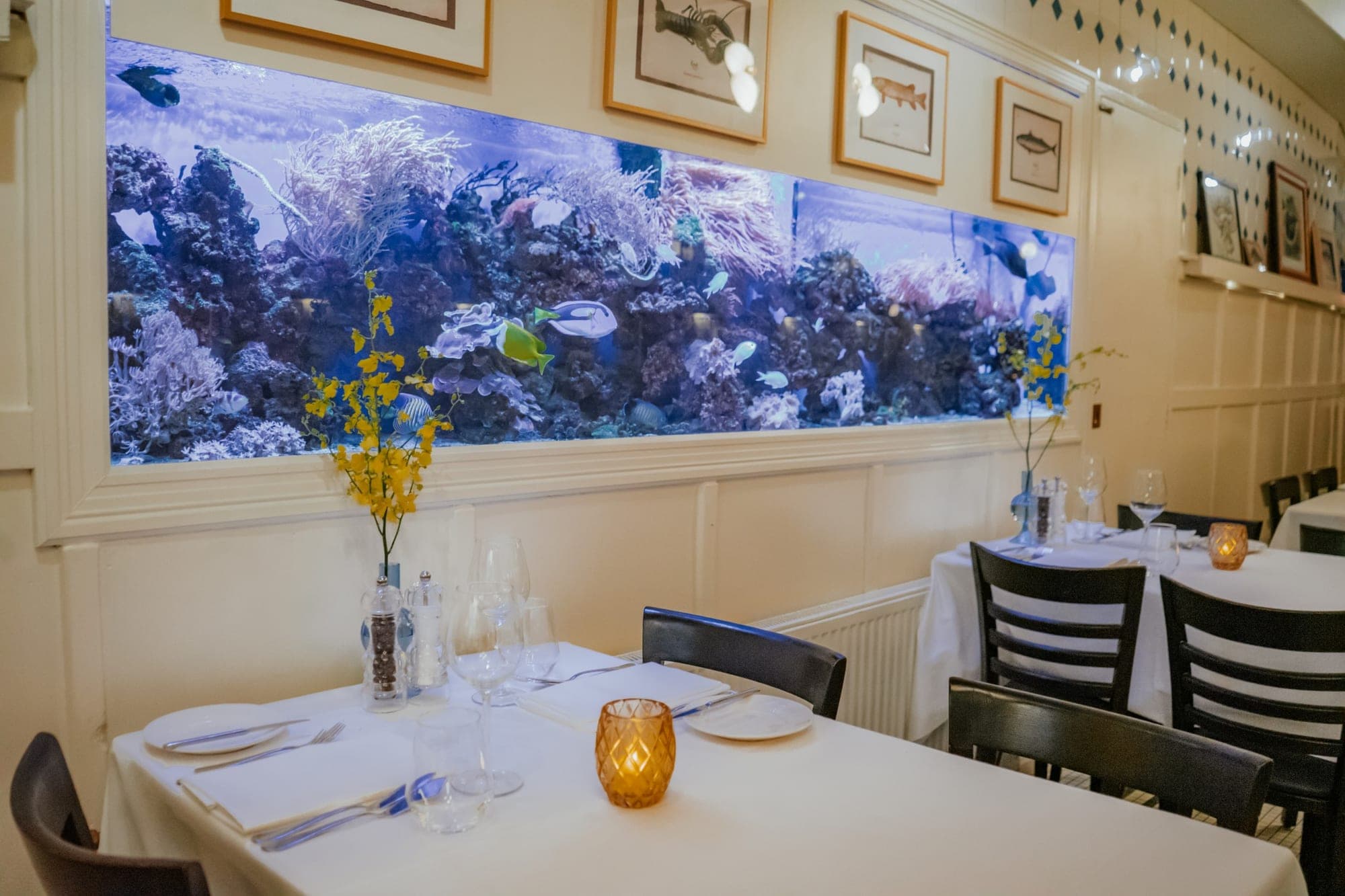
Foto: Lucius
№ 20Spui · Seafood · €€€8.0
De visklassieker van Amsterdam sinds 1975: oesters, Noordzeetong, nul fratsen.
Lucius steekt al sinds 1975 oesters open aan de Spuistraat, en de zaak ziet er nog steeds naar uit: tegels, een lange bar, aquaria die oplichten in de etalage, obers die elke toeristengolf voorbij hebben zien rollen en zich nergens meer druk om maken. Je komt voor het plateau de fruits de mer, een opgestapelde etagère van oesters, krab, langoustines en garnalen, of voor een hele Noordzeetong van de gril waar niets slims mee is uitgehaald. De wijnkaart neigt naar wit en koud, precies zoals het hoort. Goedkoop is het niet en vernieuwend evenmin; het is een klassieker die vijftig jaar openbleef door simpelweg goed te blijven. De keuken draait elke avond door tot 22:30 uur, met lunch vanaf 12:30 uur van vrijdag tot en met zondag. Ga in je eentje aan de bar zitten met zes oesters en een glas chablis en voel je in alle stilte verheven boven iedereen buiten.
Bestel · Deel het plateau de fruits de mer met zijn tweeën, met een fles chablis erbij.
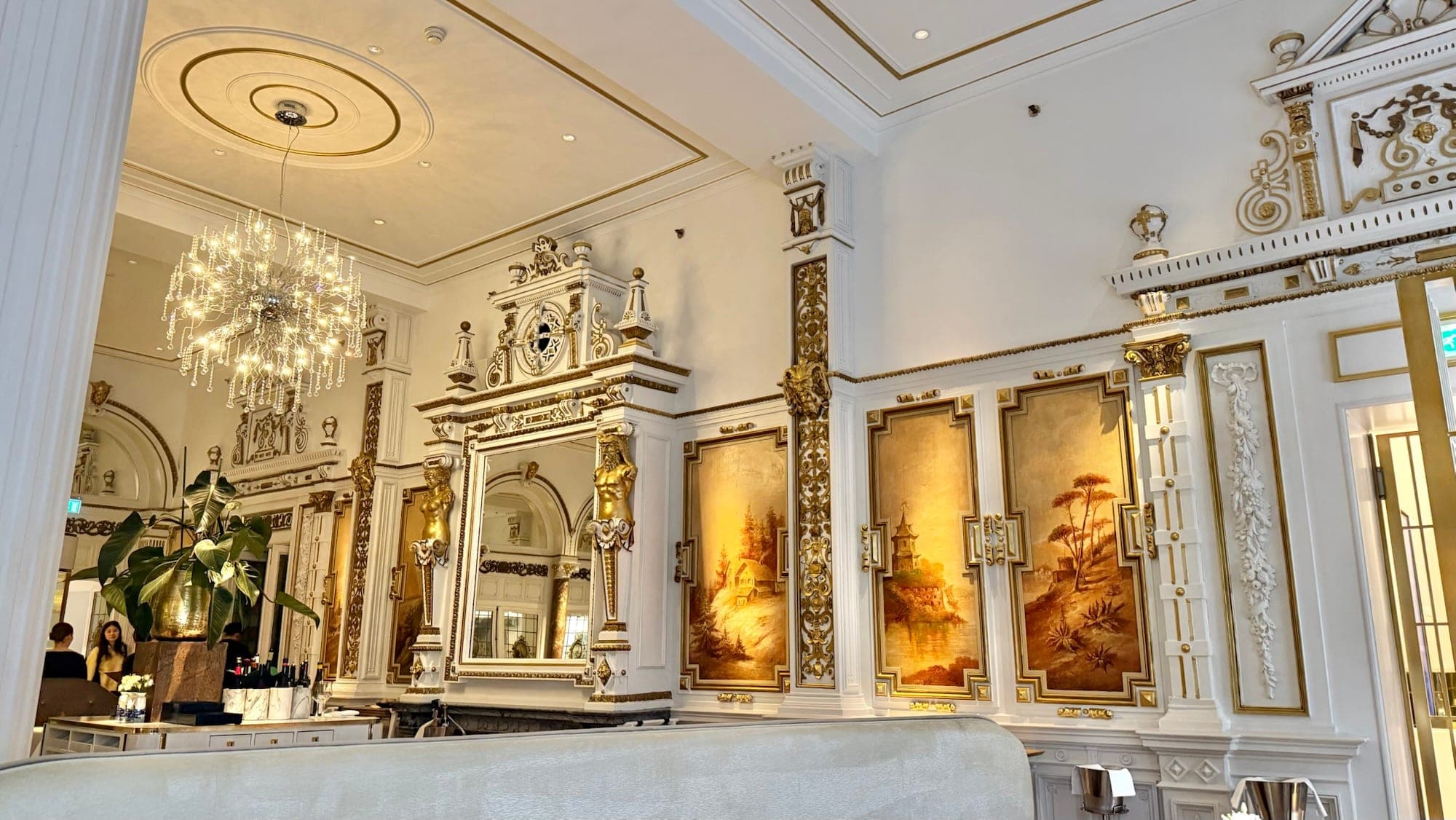
Foto: The White Room, via Stefan Gourmet
№ 21Dam / Magna Plaza · Modern French, Dutch-Asian influences, Michelin-starred · €€€€8.0
Jacob Jan Boerma bouwde zijn sterrenzaak in de oude balzaal van Krasnapolsky; Tristan de Boer kookt er nu, terwijl Boerma bij Blik weer zelf achter het fornuis staat.
De Witte Zaal dateert uit 1885 en is nog steeds de statigste ruimte van de stad om in te eten: bladgoud aan het plafond, kroonluchters, wandpanelen die niemand heeft durven aanraken. Jacob Jan Boerma bouwde hier in 2016 The White Room, op de reputatie van drie sterren bij De Leest, en had binnen een paar jaar zijn eigen ster te pakken. In 2021 gaf hij de pollepel door aan Tristan de Boer, geboren en getogen in Amsterdam, maar hij vertrok niet helemaal: op de eigen site staat hij nog altijd als signature chef vermeld, geen schone breuk dus, eerder een overdracht met een hand die nog even op de rug blijft liggen. De keuken van De Boer volgt de oude handelsroutes van de stad: Indonesische, Japanse, Thaise en Surinaamse lijnen lopen door Nederlandse producten heen, verdeeld over twee menu's, Gold en Green, allebei 185 euro, allebei gebouwd rond citrus, zuur en smaakcombinaties die een kleinere zaak niet zou aandurven. Boerma zelf staat sinds 2025 weer echt te koken, bij bistrobar Blik aan de andere kant van de stad, losser en goedkoper. De twee zaken lezen als een setje: de ene is het formele adres waar zijn naam nog op de deur hangt, de andere is waar hij zijn stropdas losknoopt.
Bestel · Diner wo-za vanaf 18:00 (laatste binnenkomst 20:15), lunch alleen op zaterdag van 12:00-16:00 (laatste binnenkomst 13:15), zo-di dicht. Gold en Green kosten allebei 185 euro; de klassieke wijnpairing van 130 euro geldt voor beide menu's.
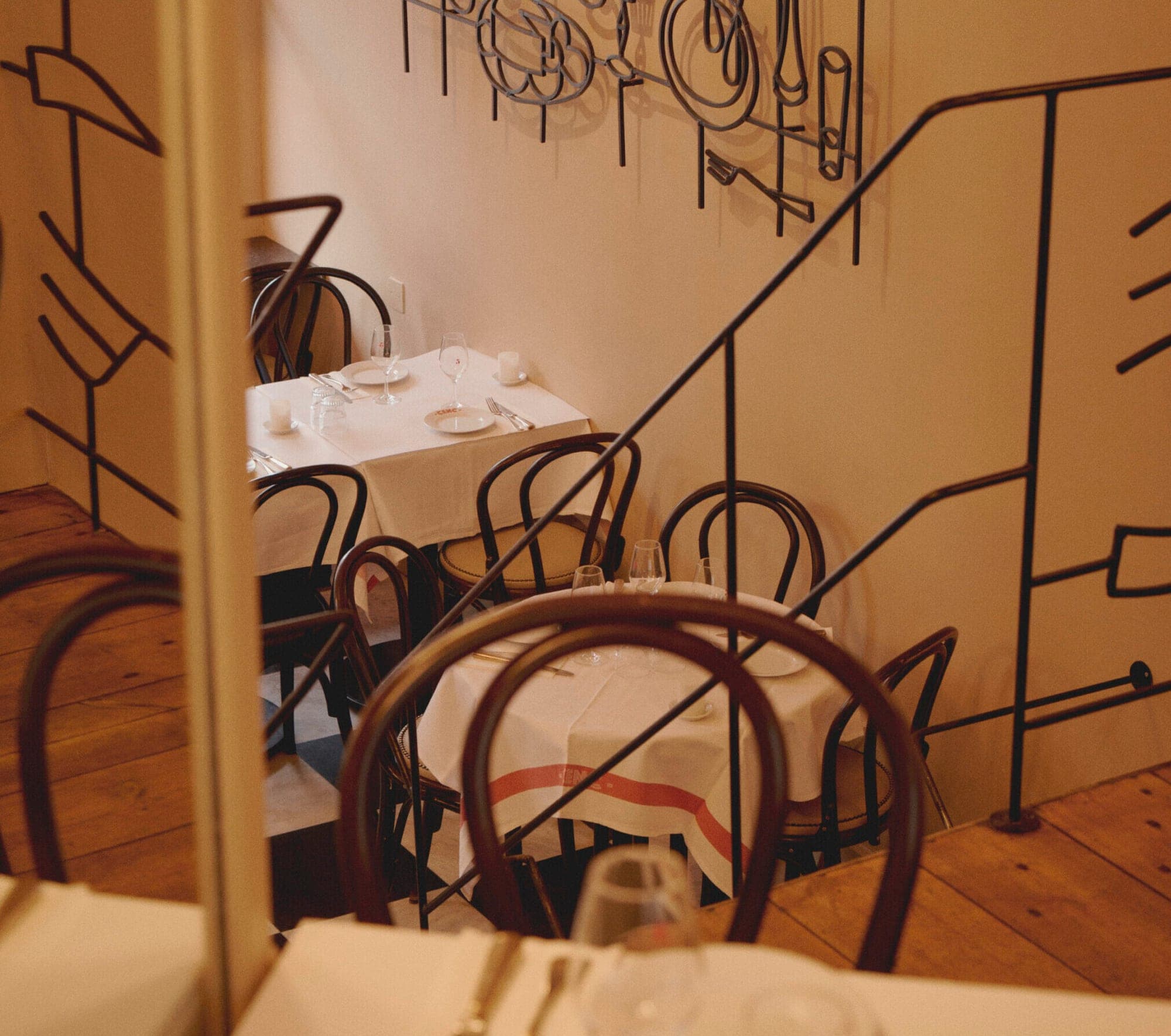
Foto: Café Cenc
№ 22Weteringschans · Mediterranean · €€€8.0
Viscentraal mediterraans van de familie achter Balthazar's Keuken en Bar Parry, sinds 2024 aan de Vijzelgracht.
Café Cenc is het derde bedrijf van de familie achter Balthazar's Keuken en Bar Parry, en het eerste van de drie dat is opgezet als volwaardig restaurant in plaats van een vast menu of een borrelbar. Sinds juni 2024 zit de zaak op het oude adres van Bar Bambino aan de Vijzelgracht en heeft het een viscentrale, mediterrane richting gekregen: brioche met garnaal en citroenmarmelade, gravad lax met gepekelde rode ui, een hele vis met gekarameliseerde venkel en harissa, poulet jaune met spitskool en dragonsaus. Bestel à la carte of neem het vaste driegangenmenu van 45,50 euro, van voor- tot nagerecht, zonder echt zwak punt in beide routes. Overdag draait dezelfde keuken gewone broodjes, garnalenkroket op stokbrood, gerookte makreel met citroenmayonaise, plus snacks als eiermayonaise en visbeignets, door tot 22:00. De wijnkaart, weer via De Wijnwinkel, leunt Portugees, Spaans en Italiaans. Zes dagen open, ma en di dicht, en het zit er net zo snel vol op instinct als op reservering.
Bestel · Open wo-zo vanaf 12:00, lunch loopt door in het diner. Er staat inmiddels een reserveringswidget op de site, maar de zaak bouwde haar naam op walk-ins, dus een plek aan de bar blijft altijd een optie.
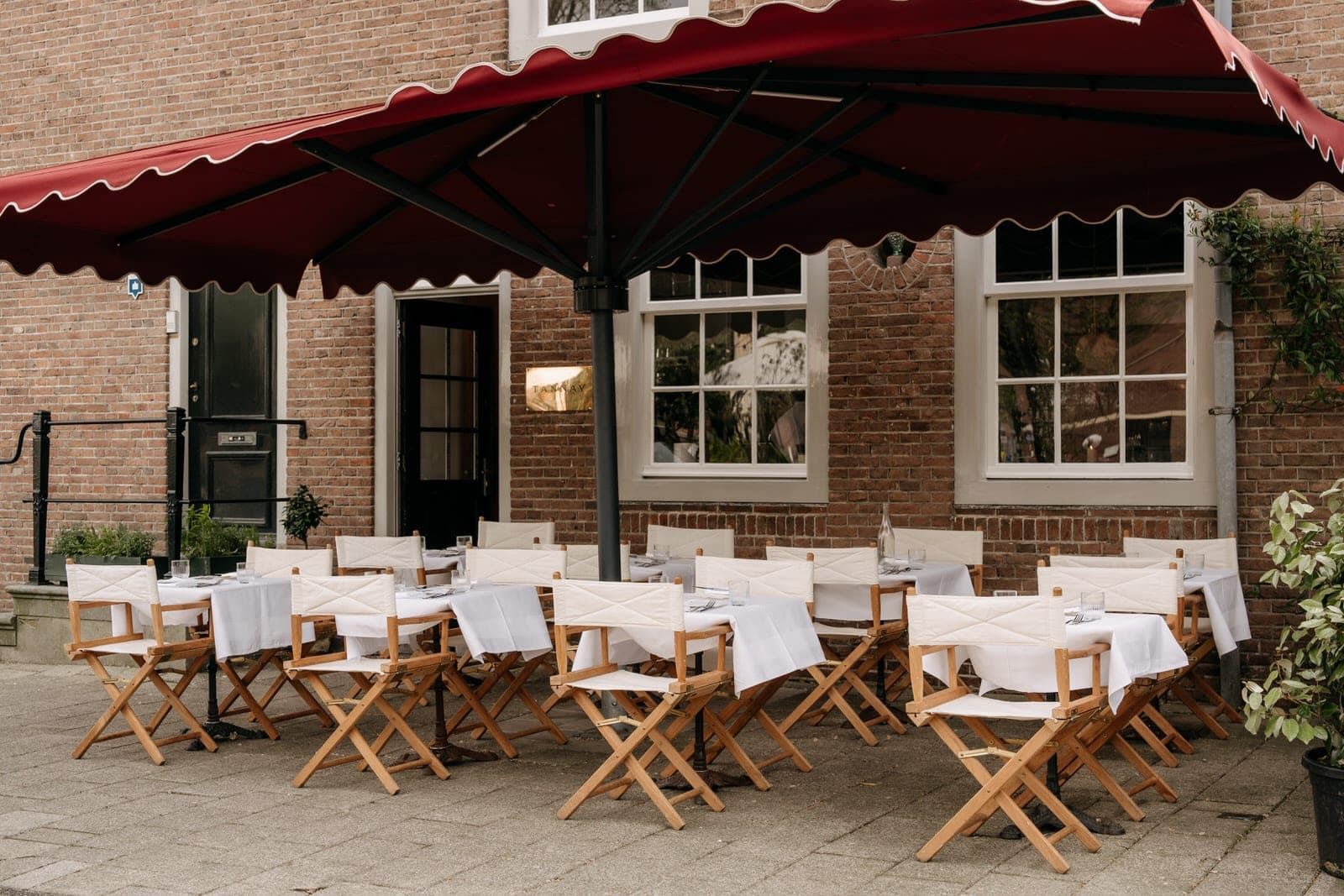
Foto: Tannay / Chantal Arnts
№ 23Realeneiland (Zandhoek) · Classic French · €€€€8.0
Het Franse huis van de familie Caron, vernoemd naar het Bourgondische dorp van de chef, met een terras aan de ophaalbrug.
Jarenlang heette dit De Gouden Reael, het Franse vlaggenschip van Alain Caron aan de Zandhoek. In april 2024 gaf de familie het de naam van het Bourgondische dorp waar chef Thomas Demuth opgroeide, en dat is geen loze verwijzing: zijn ouders runnen daar nog altijd een wijngaard, en hun flessen staan op de kaart. Demuth leerde het vak bij de George V in Parijs en kookt klassiek Frans met sauzen die kloppen, als vijfgangenmenu van de chef voor 92 euro of à la carte, uit een kelder die zwaar op Bourgogne, Loire en Champagne leunt. De plek doet de rest van het werk: een monumentaal zeventiende-eeuws pand op het Realeneiland, met een terras bij de oude ophaalbrug waar een middag geruisloos verdwijnt. In het weekend is er lunch met een driegangen Menu du Marché voor 58 euro, de verstandige eerste kennismaking. Michelin heeft het in de gids, de Westelijke Eilanden blijven stil, de eenden peddelen voorbij.
Bestel · Begin met de Menu du Marché-lunch in het weekend (za-zo 12:30-14:00, drie gangen), het liefst op het terras aan de ophaalbrug. Diner wo-vr 18:30-20:30, in het weekend 18:00-20:30.
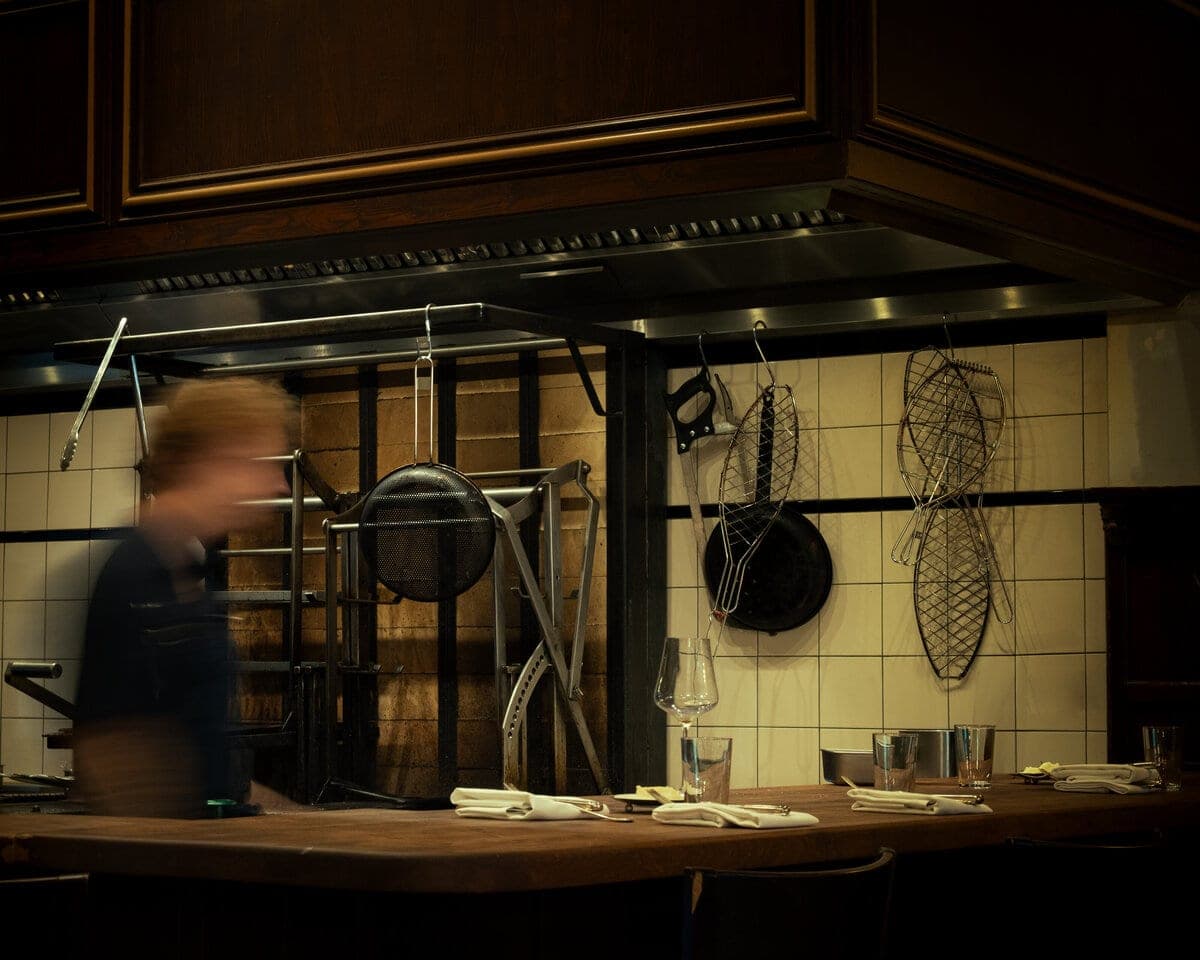
Foto: Veneur
№ 24Weteringschans · French, game and open fire · €€€8.0
Het team van De Juwelier ging jagen: Frans koken op houtvuur, met een hertenkotelet voor de hele tafel.
Een deel van het team achter het besterde De Juwelier begon voor zichzelf in een gelambriseerde zaak aan de Weteringschans, bouwde er een vuur van hout en kolen en koos een naam die de kaart in één woord samenvat: veneur, Frans voor jachtmeester. Chefs Yoran Jacobi en Moriaan Koeleman koken wild en grill met Franse techniek en directe smaken: hertentartaar Andalouse, dronken konijn met girolles, salade van houtduif met gerookte kersen, en voor de hele tafel een hertenkotelet Grand Veneur van 400 gram. Mede-eigenaar en sommelier Bas Hazen schenkt van een kaart die Star Wine List haalde, en Michelin zette de zaak al in de gids. Het oude lijstwerk is gebleven, de poespas die je bij dit genre zou vrezen is nooit gekomen. Van vrijdag tot en met zondag is er ook echte lunch, en een zondagmiddag hier, met het vuur aan, voelt als Frankrijk met betere fietsenstalling.
Bestel · De zondagslunch (12:00-15:00) is de makkelijkste tafel en het vuur brandt dan de hele dag. Kom je voor het diner, deel dan de hertenkotelet Grand Veneur van 400 gram. Maandag dicht; di-do alleen diner vanaf 17:30.
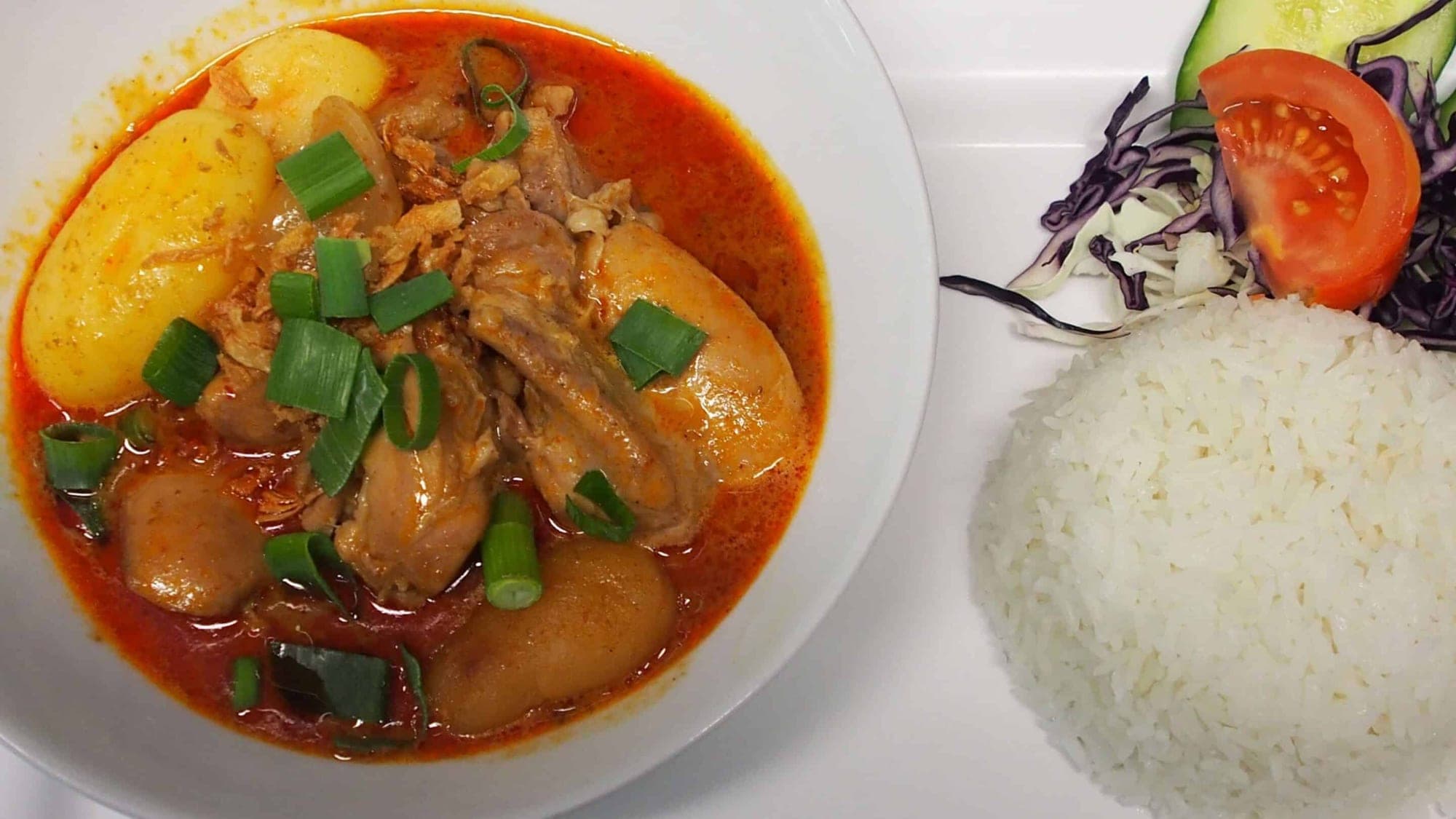
Foto: Bird Thai Restaurant
№ 25Chinatown / Zeedijk · Thai · €€7.9
Het Thaise anker van de Zeedijk: curry's zoals het hoort, teak waar je ook kijkt, en geen enkele concessie aan bange tongen.
Bird begon aan de overkant, op Zeedijk 77, als een snackbar ter grootte van een wok, en liep zo storm dat de familie op nummer 72-74 deze grotere zaak vol teakhouten snijwerk opende; sinds de jaren negentig zitten ze allebei vol. In een buurt waar de helft van de menukaarten geplastificeerde valstrikken zijn, is Bird het echte werk: Thaise koks, Thaise porties, en eerlijkheid over pittigheid. Zeggen ze phet, geloof ze dan. Bestel de massaman met kip, de som tam die daadwerkelijk terugbijt of een hele vis met knoflook en peper, en zie hoe de tafel Thaise studenten met heimwee naast je precies hetzelfde bestelt. Contant betalen gaat prima, het tempo ligt hoog, het volume ook, en de zaak is elke dag open van twaalf tot 22:30 uur, wat naar Amsterdamse keukenmaatstaven zo ongeveer als nachtleven telt. Groepen passen er moeiteloos in; romantiek niet. Ook prima.
Bestel · Neem de massaman: traag, vol kokos, met aardappels waarin alle goede beslissingen zijn getrokken.
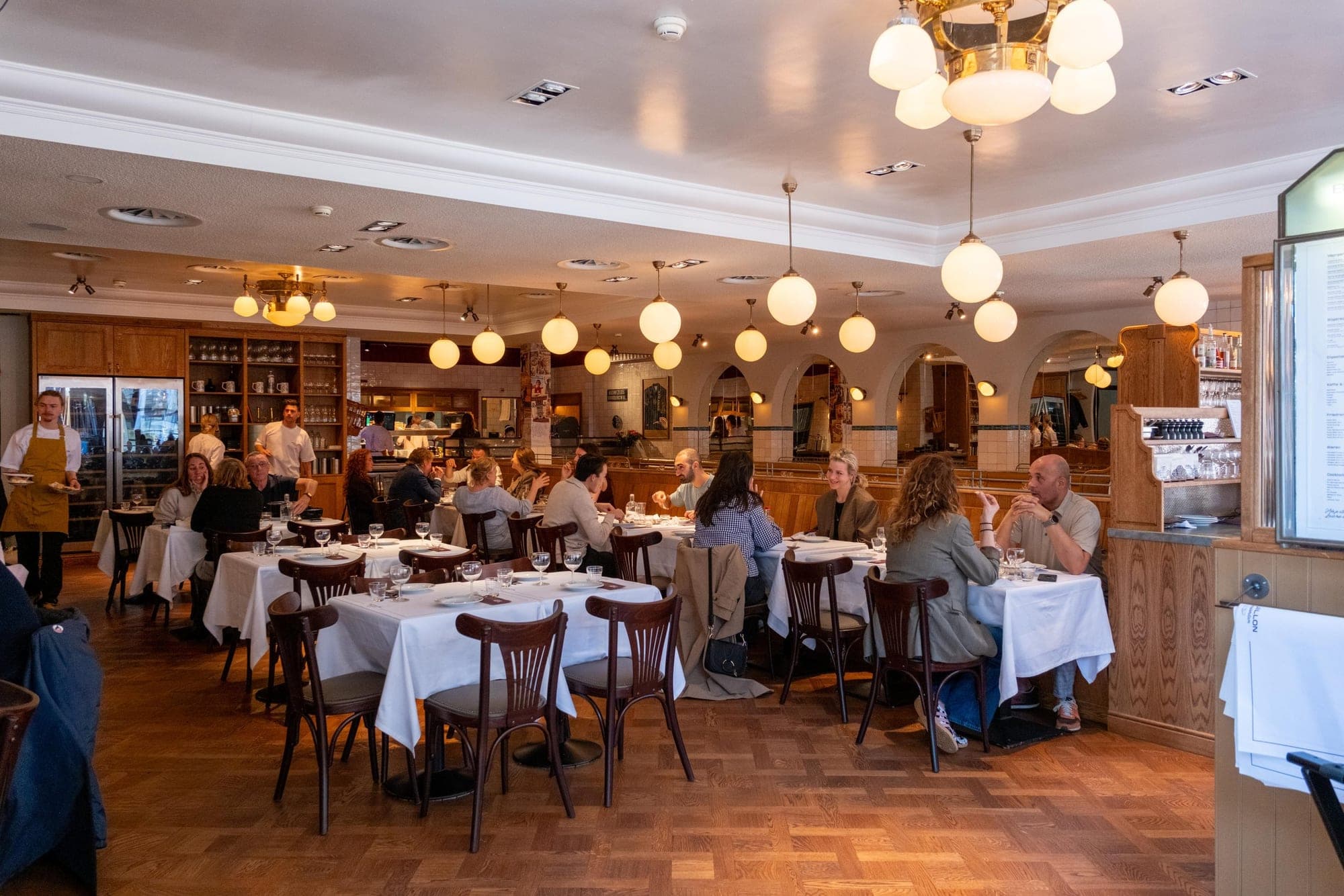
Foto: Bouillon d'Amsterdam (A Delicious Story)
№ 26Dam / Magna Plaza · French bouillon classics · €7.9
De Parijse bouillonformule strijkt neer achter de Dam: steak frites voor €16.90, oeufs mayo voor kleingeld, en een tent vol echte Amsterdammers.
Amsterdam kijkt al een decennium toe hoe de binnenstad iets werd waar bewoners zich voor verontschuldigen, dus toen Michiel van der Eerde (de man van BAUT) met partners de Parijse bouillonformule in Hotel Die Port van Cleve installeerde, reageerde de stad door elke stoel te bezetten. De formule kwam ongeschonden over: een grote, gonzende ruimte, lange tafels, bediening in draf, en klassiek Frans koken tegen prijzen die als een drukfout lezen. Oeufs mayonnaise voor 3.60, uiensoep gegratineerd met Old Amsterdam voor 6.40, en als kroonnummer de steak frites 'Cafe de Paris' voor 16.90, gesneden van de genummerde biefstuk die Die Port van Cleve al sinds 1874 serveert. Goedgekozen Amsterdamse accenten (hier een augurk van Kesbeke, daar een appeltaart uit het Groene Hart) houden het aan de goede kant van pastiche. Overdag draait de hoek aan de Molsteeg als Bouillon Service, met koffie en stapels stokbrood vanaf negen uur. Het sloeg zo aan dat er binnen vier maanden een compacte tweede vestiging opende, Le Petit, in het oude pand van BAUT in Zuid. TripAdvisor zet de zaak al in de top honderd van de stad, en het zit er opvallend vol Amsterdammers, wat achter de Dam als een klein wonder telt.
Bestel · Binnenlopen zonder reservering is hier de huisreligie, maar het zit er snel vol; boek online of glip binnen voor 18:00 uur, en begin met de oeufs mayonnaise terwijl je nadenkt.
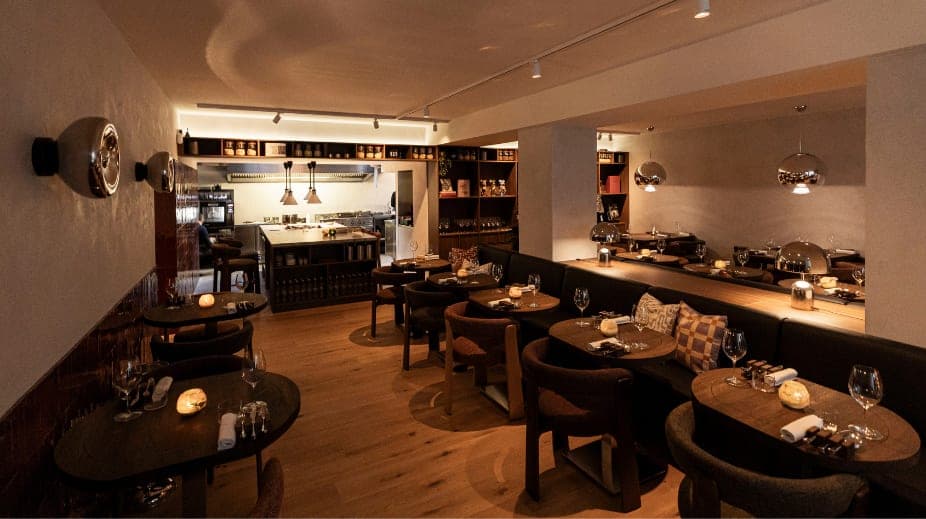
Foto: Entree Magazine
№ 27Weteringbuurt · Modern French with Asian accents · €€€7.9
Het chefduo van Wolf Atelier gaat à la carte: één ingrediënt, twee bereidingen, prijzen die zich netjes gedragen.
Vijftien jaar is een lange leertijd voor een dubbele naamsvermelding. Michael Wolf en Jordy Koopmans stonden zij aan zij bij Envy en daarna Wolf Atelier, voordat ze begin maart 2026 Amice openden, Latijn voor vrienden, in een voormalig Thais restaurant aan de rustige Noorderstraat. Het uitgangspunt is ontwapenend simpel: een handvol seizoensingrediënten, elk in twee bereidingen. De tonijn komt dus rauw met aguachile, jalapeño en kumquat, of rauw met rode peper en Griekse yoghurt; de witte asperge komt van de barbecue met daslook of gaat door een risotto. De meeste borden zitten tussen de 14 en 24 euro, wat je bij koks van dit kaliber gerust een publieke voorziening mag noemen. Concrete, van 212 en NENI, tekende voor het interieur: warm hout, diep groen en bruin, een open keuken waar je echt mee kunt praten en een wijnkamer waar je zelf je fles pakt, vanaf 35 euro. De eerste recensies zijn zonder uitzondering verliefd, van een goedkeurend knikje van Barts Boekje tot bloggers die schrijven dat het voelt als thuiskomen bij vrienden die toevallig op fine-diningniveau koken. Met zijn tweeën is de hele zeetong met kokkels en citroen van de barbecue het slotpleidooi. Open tot 01:00 uur, en daar zat deze hoek van het Centrum stilletjes op te wachten.
Bestel · Bestel één ingrediënt in allebei de bereidingen, daar draait het hier om, en haal daarna zelf je fles uit de wijnkamer. Het dessert is het wentelteefje met tiramisucrème, en ja, dat werkt.
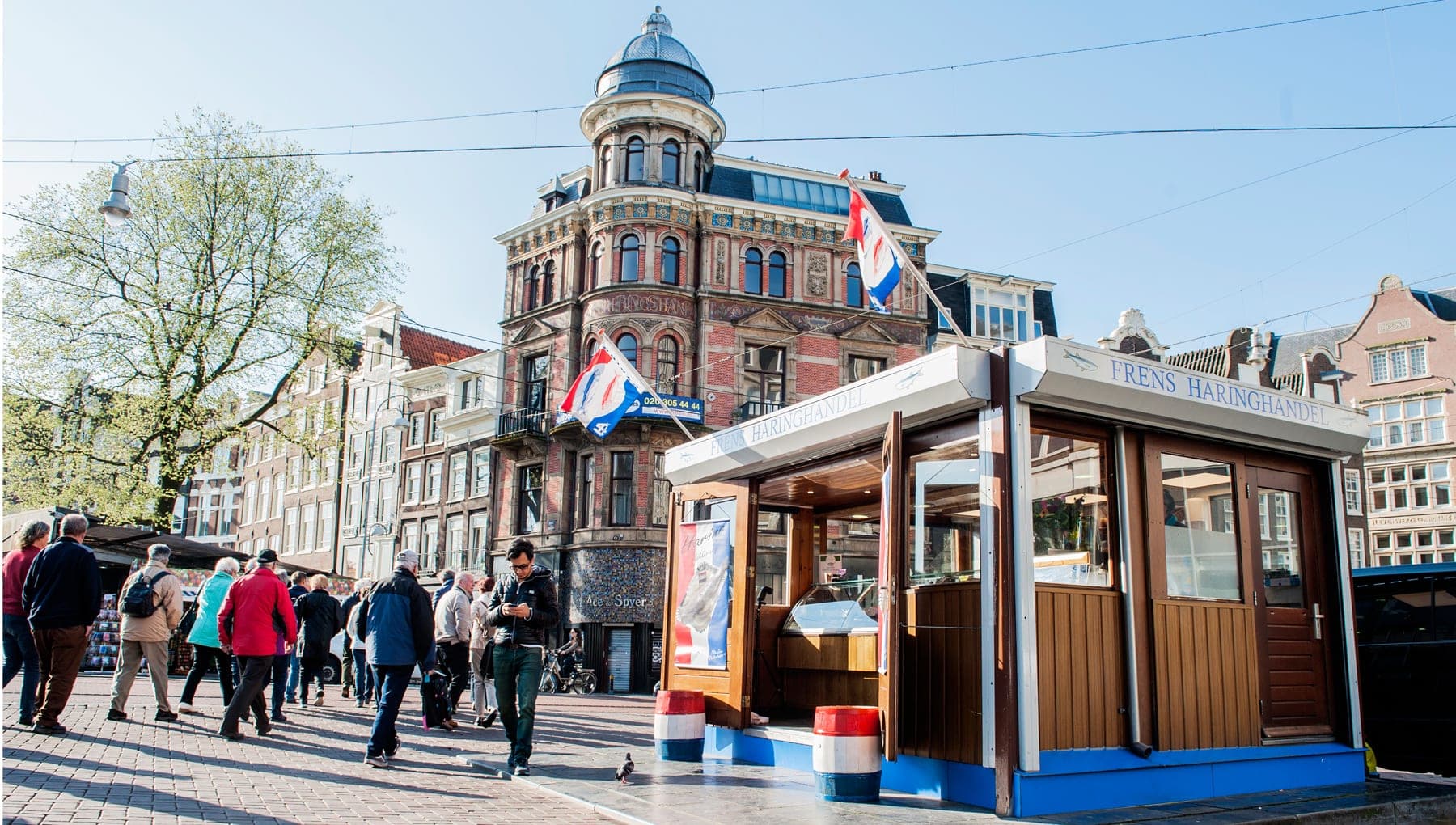
Foto: Frens Haringhandel via I amsterdam
№ 28Koningsplein / Bloemenmarkt · Dutch herring stall · €7.9
Rauwe haring op de hoek bij de bloemenmarkt; nergens in het Centrum lunch je zo goed voor zo weinig.
Elke stad heeft een kraam nodig waar de lunch een vijfje kost en naar de Noordzee smaakt. Frens is die kraam sinds 1976, op de hoek van Singel en Koningsplein naast de bloemenmarkt, al die tijd gerund door dezelfde familie. De bestelling is een broodje haring: zijdezachte rauwe haring, scherpe rauwe ui, plakjes augurk, een zacht wit bolletje, in zo'n veertig seconden in elkaar gezet door mensen die meer vis hebben gesneden dan jij ooit hebt gegeten. In juni, als de Hollandse Nieuwe binnenkomt, vouwt de rij zich om de kraam heen en bestaat de helft ervan uit vaste klanten die hun haring in zijn geheel nemen, staart omhoog, zoals op de ansichtkaart. Kibbeling en gerookte paling zijn er voor de voorzichtigen. Zitten kan nergens en er valt niets te zien behalve tulpenverkopers en grachtenverkeer, en dat is dus een perfect uitzicht.
Bestel · Broodje haring met uitjes en augurk; in het seizoen vraag je om de Hollandse Nieuwe
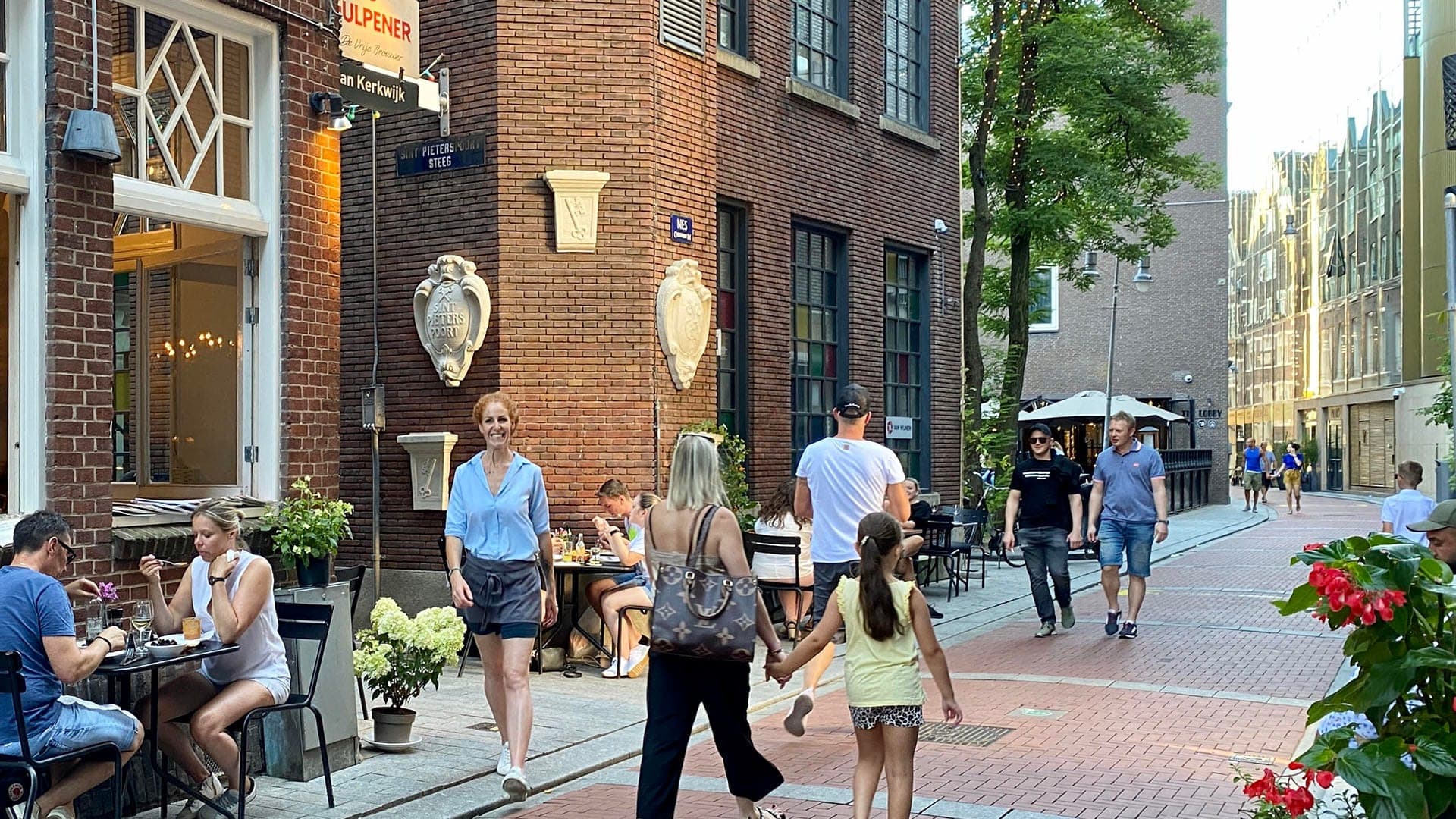
Foto: Van Kerkwijk
№ 29Nes · Bistro · €€7.8
Geen kaart, geen reserveringen: de ober draagt voor, jij kiest, iedereen blij.
Een gedrukte menukaart is er niet en die komt er ook nooit. De ober schuift aan en draagt uit het hoofd de vijf of zes hoofdgerechten van die avond voor, altijd een steak, altijd een vis, meestal iets met een Indonesische inslag of een serieus vegetarisch bord, en jij beslist ter plekke; dat werkt gek genoeg bevrijdend. Het is er hoog, met houten lambrisering en kaarslicht, aan de Nes, de oude theaterstraat op één blok van de Dam die toeristen op wonderbaarlijke wijze nooit vinden. Hoofdgerechten blijven rond de twintig euro of net erboven hangen, de porties kloppen, en de entrecôte met jus uit de pan verdwijnt zelden van het repertoire. Reserveren kan evenmin: naam opgeven, een drankje aan de bar of buiten op straat, en wachten tot je aan de beurt bent, net als iedereen. Sluit af met de huisgemaakte appeltaart; de website is er zo ongeveer een bedevaartsoord voor, terecht. Dagelijks open van 11 tot 1 uur 's nachts.
Bestel · Houd ruimte over voor de huisgemaakte appeltaart met slagroom.
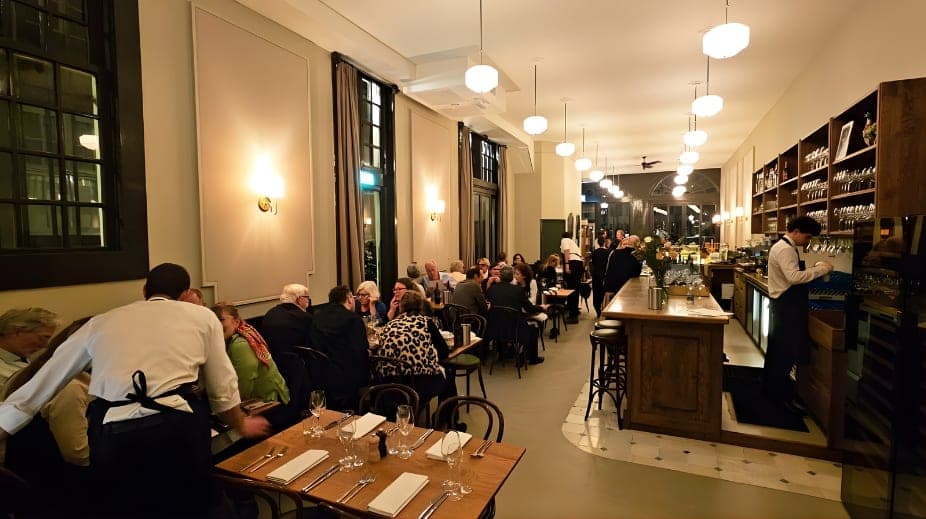
Foto: Weinlokal Stern, via Entree Magazine
№ 30Negen Straatjes · German · €€7.8
De Scheepskameel-club neemt Duits eten en drinken serieus in het oude pand van Breda aan het Singel.
Het oude kaaspakhuis van Breda aan het Singel stond leeg tot drie Scheepskameel-alumni er introkken met een idee dat Amsterdam gek genoeg nog niet had: Duitsland behandelen als serieus etenland. Chef Luke de Jong, daar jaren souschef, kookt Neue Deutsche Küche, en dat betekent in de praktijk een kalfsschnitzel met echt vakwerk, schweinshaxe, spätzle, oesters van de Duitse Waddeneilanden en een Spaghetti-Eis zonder een spoor van ironie. Mo Moody en Chanan Wisse, Magister Vini, schreven de kaart: alles onder de 75 euro is Duits en veel ervan gaat per glas, met bourgogne en champagne wachtend boven die streep. Rothaus op de tap, fritz-kola in plaats van cola, en koude schnaps als de avond die kant op kantelt. Sinds de opening in februari 2026 zitten de zestig stoelen snel vol, maar de tien barkrukken zijn gebouwd om alleen aan te schuiven. De Buik noemde het supergeil. Na die schnitzel valt daar weinig tegenin te brengen.
Bestel · Zondag is de slimme zet: dan gaat de deur al om 12:30 open voor de enige dagdienst van de week, en de bar neemt walk-ins.
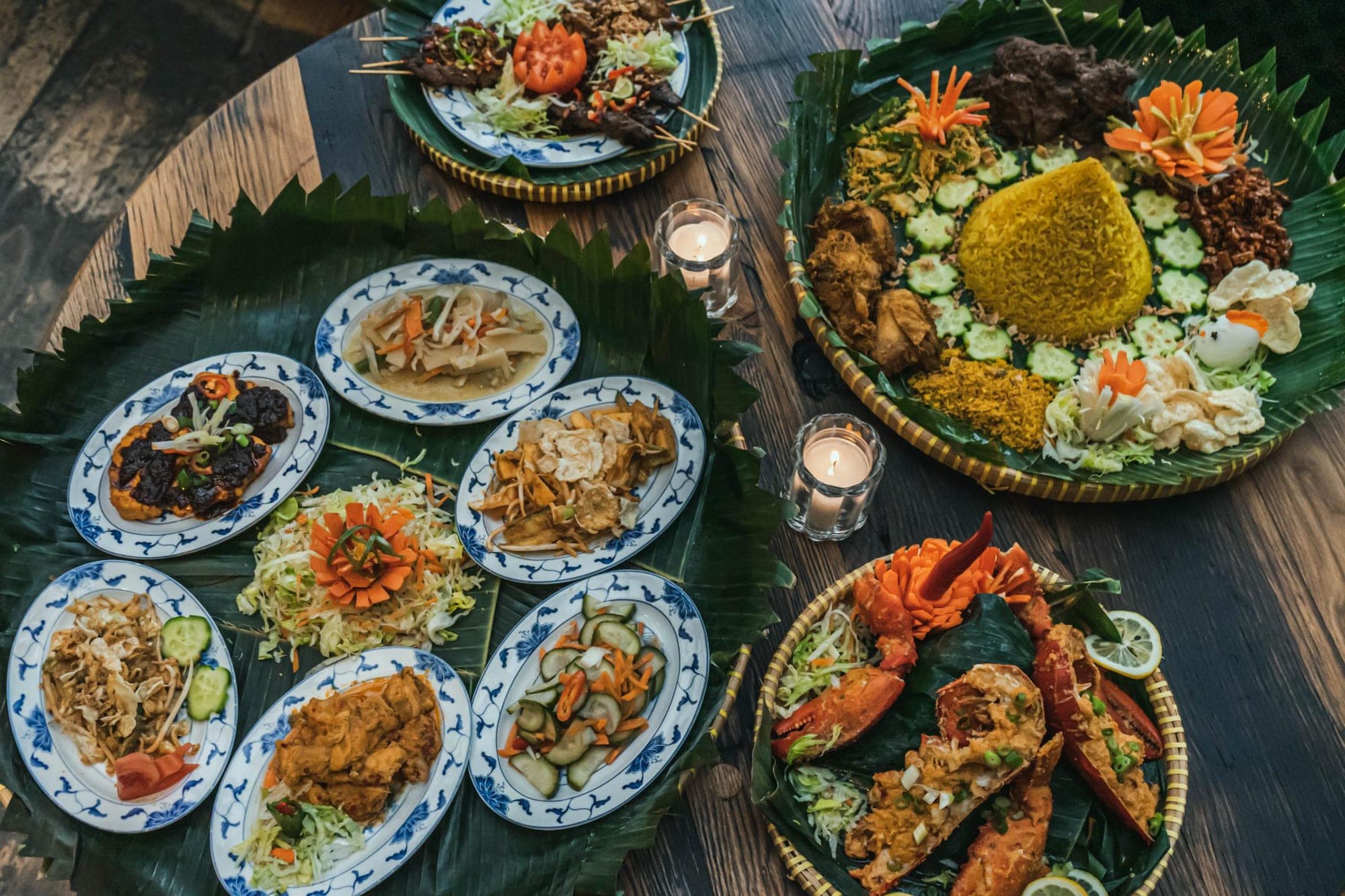
Foto: Indrapura
№ 31Rembrandtplein · Indonesian · €€€7.7
Het statige oude rijsttafelrestaurant van het Rembrandtplein, nog altijd de klassieke Indonesische dis.
Tempo Doeloe, jarenlang de fakkeldrager van de rijsttafel op de Utrechtsestraat, ging in 2021 failliet; met die trek ga je nu naar Indrapura. Hier wordt sinds 1987 Indonesisch uit de koloniale tijd geserveerd aan het Rembrandtplein: een grote, statige ruimte, donker hout en warm licht, obers die je door de vijftien of wat schoteltjes heen praten terwijl ze neerdalen. Bestel de rijsttafel en zie de tafel verdwijnen onder rendang, gado-gado, sambal goreng boontjes, saté en een sambal terasi die geen grapjes maakt; geef eerlijk je pittigheidsgrens door en ze stemmen erop af. Grote gezelschappen en diners met overgevlogen ouders vangt de zaak op zonder te zweten, de keuken draait dagelijks tot 22:30 uur, laat voor dit genre, en vegetariërs krijgen een volwaardige eigen rijsttafel in plaats van een sluitpost. Op een plein dat van gevel tot gevel uit toeristenvallen bestaat, is dit de zaak die gerund wordt door mensen die erom geven.
Bestel · Neem de volledige rijsttafel en vraag de sambal terasi er apart bij.
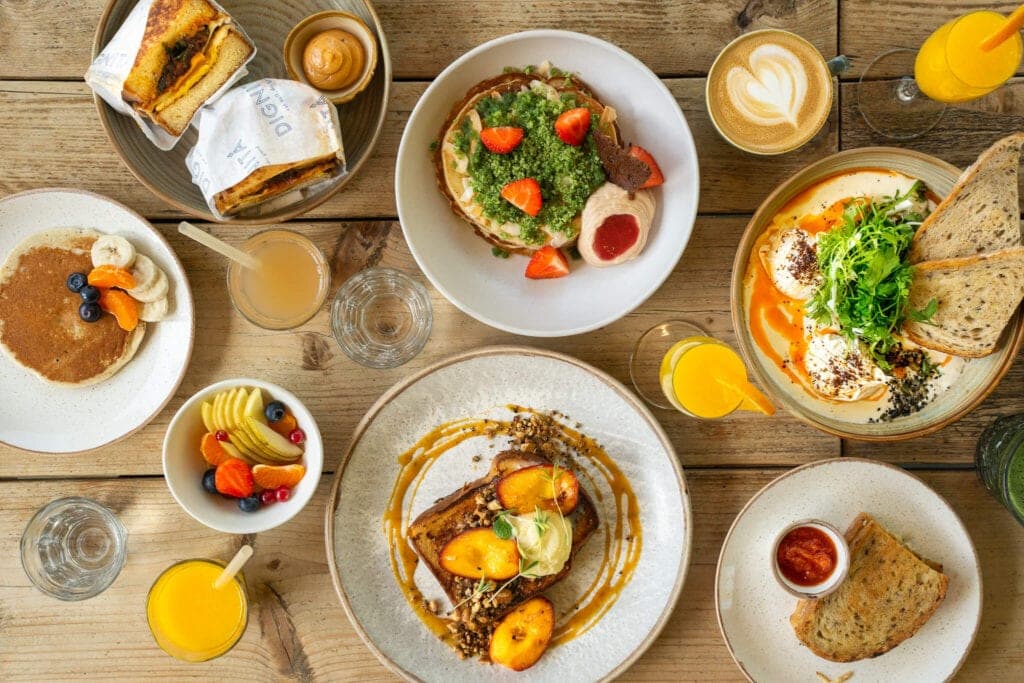
Foto: Dignita
№ 32Hoftuin, Nieuwe Herengracht · All-day brunch, social enterprise · €€7.7
Elke euro winst gaat naar Stichting Dignita, en de ommuurde Hoftuin achter het H'ART Museum is het rustigste brunchterras van het centrum.
Dignita is eerst een sociale onderneming en pas daarna een brunchzaak, wat alleen bijzonder is omdat het eten goed genoeg is dat je toch was gegaan. Alle winst gaat naar Stichting Dignita, die mensen in een kwetsbare positie opleidt en begeleidt, en de keuken serveert hier naar eigen zeggen sinds augustus 2015 brunch. De kaart is doordachter dan het format meestal toelaat: Brave the Lamb is lamsschouder van zestien uur met tahinilabneh en een gebakken ei met feta voor 22 euro, Green and Gold zet gepocheerde eieren naast maïssalsa en een aardappelrösti voor 17 euro, Bright Side Eggs houdt het op gebakken eieren op zuurdesem van Farine met krokante chiliolie voor 15 euro, en de Bananoffee French Toast van 17 euro doet de zoete helft zoals het hoort. De inkoop is met naam en toenaam na te trekken: koffie van Rum Baba, brood van Farine en in eigen huis gebakken, groente, eieren en vlees van Lindenhoff. De locatie is het argument om te komen: een ommuurde tuin weggestopt achter de voormalige Hermitage, nu het H'ART Museum, waar de tafels onder de bomen een zaterdagochtend laten verdampen. Eén voorbehoud dat je moet weten, omdat wij het zelf ook zouden willen horen: de groep is gekrompen in plaats van gegroeid, Dignita Westerpark sloot op 1 september, de site is nu alleen Nederlands en bevat op plekken nog onaffe placeholdertekst. Hoftuin is degene die er nu toe doet, en die houdt zich prima staande.
Bestel · Zeven dagen open, 09:00 tot 17:00, met een aperitiefkaart vanaf 16:00. Boek het weekend via de Formitable-widget op hun site, de tafels in de tuin gaan als eerste en ze gaan vroeg. Bestel Brave the Lamb van 22 euro, met de Melbourne wedges van 6,50 euro erbij.
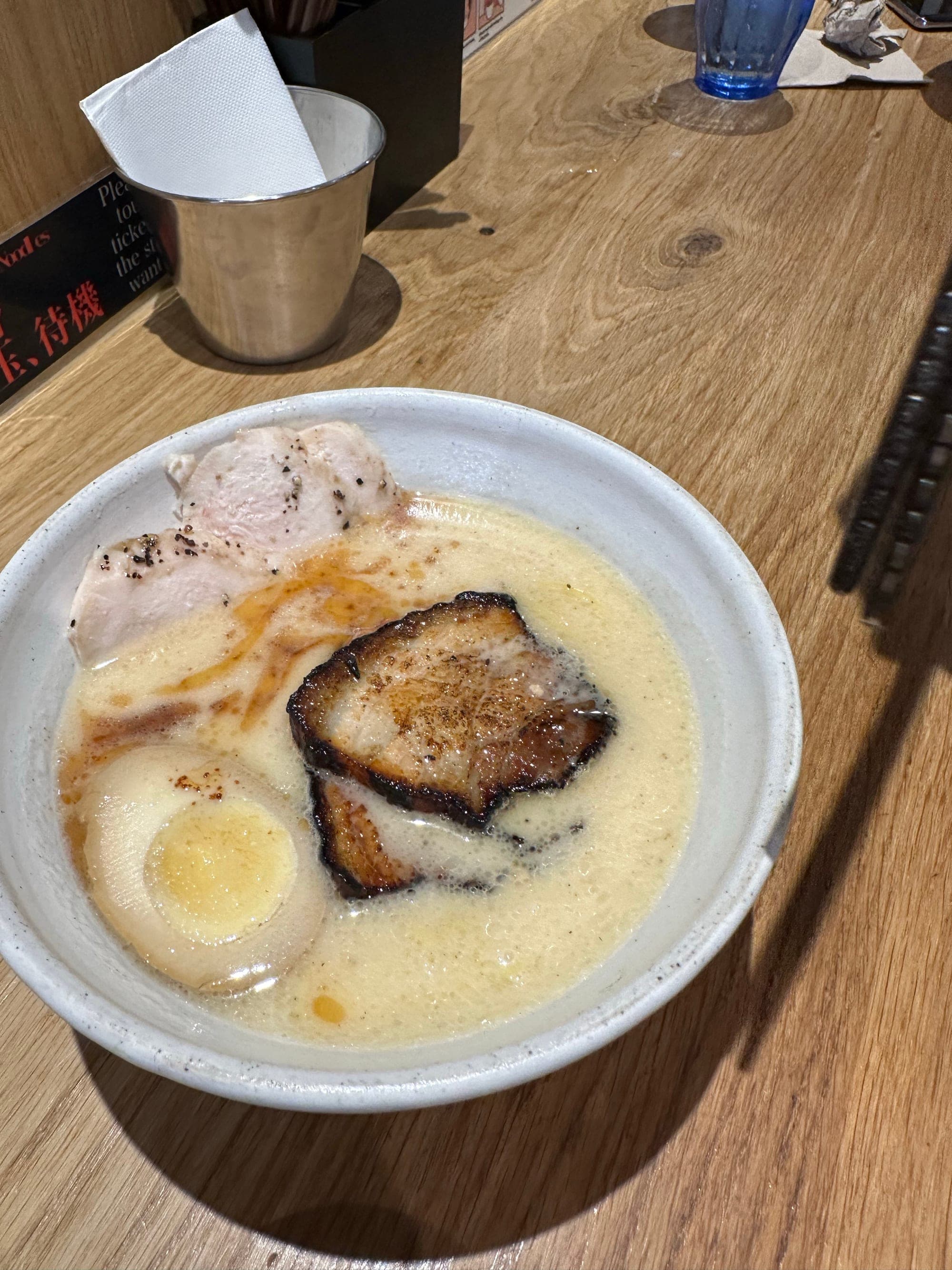
Foto: Amsterdam Wonderland
№ 33Prins Hendrikkade · Ramen · €€7.7
De culttoonbank bij Centraal is terug na twee donkere jaren: zelfde rijke bouillon, nieuwe eigenaar, zelfde genadeloze rij.
Jarenlang was deze counter van twintig vierkante meter tegenover Centraal het cultadres voor ramen in de stad: bestellen via een touchscreen, één stoel tegelijk, One Piece-delen tussen de bakjes eetstokjes en een reusachtige Mario in het raam, plus de kom die Amsterdam Foodie tot Ramen Nirvana kroonde. Toen ging het licht uit, ongeveer twee jaar lang. In het voorjaar van 2026 kwam de comeback, en de rij kwam gewoon mee: op een weekendmiddag kan het wachten meer dan een uur duren voordat je de bestelzuil überhaupt bereikt. De keuken schenkt nog steeds die romige, diep hartige varkensbouillon onder geschroeide chashu, en het kaedama-ritueel leeft ook nog: houd je bouillon, lever je extra-noedelbonnetje in, ontvang een verse pluk. Vaste gasten van vroeger zeggen dat de kommen precies smaken zoals toen. Ze melden ook dat de eigenaar bij de overdracht is gewisseld en dat de bediening trager draait dan voorheen, en daarom blijft ons cijfer voorlopig tot we er zelf hebben gezeten. Kommen kosten rond de 20 euro, de porties zijn eerder Japans dan Hollands, en de spicy pork is nog altijd de bestelling die de legende heeft gebouwd.
Bestel · Dagelijks 12:00-22:00 onder het nieuwe bewind. Op weekendmiddagen kan de rij zomaar twee uur opslokken; doordeweeks lunchen of op zaterdag na 20:00 komen en je zit binnen enkele minuten. Minimaal één ramen per persoon, niet delen, niet reserveren.
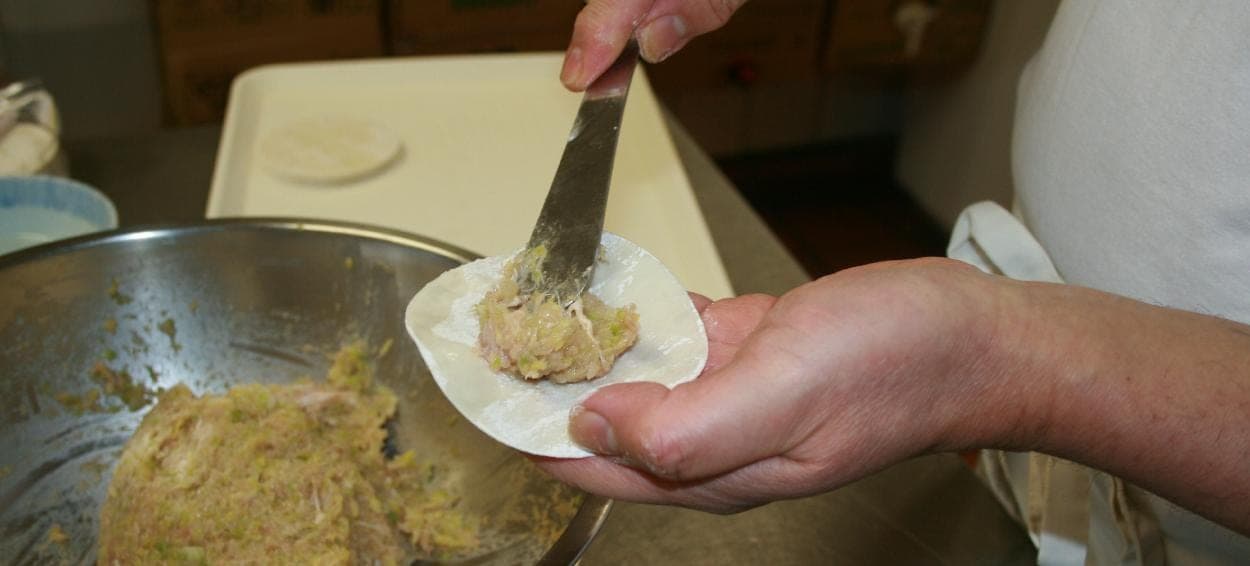
Foto: Japans Restaurant AN
№ 34Weteringbuurt · Japanese home cooking, omakase · €€7.7
Een echtpaar kookt hier sinds 1989 Japans huiselijk eten en maakt alles zelf, tot het ijs en de wagashi aan toe.
AN staat sinds 1989 aan de Weteringschans, wat het een van de oudste Japanse restaurants van het land maakt en het adres waar expats andere Japanse keukens aan afmeten. Een echtpaar runt de zaak, de keuken is open, en alles wordt met de hand gemaakt: de gyozavelletjes, het ijs, zelfs de wagashi. Die werkwijze bestond al voordat het woord ambachtelijk een verkoopargument werd, en gaat er ook langer mee. Bestel de omakase: een Japans dienblad vol kleine gerechten, sashimi, tempura, gestoofde dingen, royaal voor de prijs en stilletjes precies. Vegetariërs en veganisten worden serieus genomen in plaats van gedoogd. Het is er sober, het tempo onthaast, de ontvangst oprecht hartelijk. Na bijna veertig jaar zoekt AN geen aandacht en heeft het die ook niet nodig: na de zomersluiting gaat de deur gewoon weer open en druppelen de vaste gasten vanzelf terug. Reserveren doe je per telefoon, zoals in 1989.
Bestel · Wegens zomervakantie dicht tot 1 september 2026. Normaal diner di-za 18:00-22:00, laatste bestelling 21:30, zondag en maandag gesloten. Bel om te reserveren en zeg gewoon omakase.
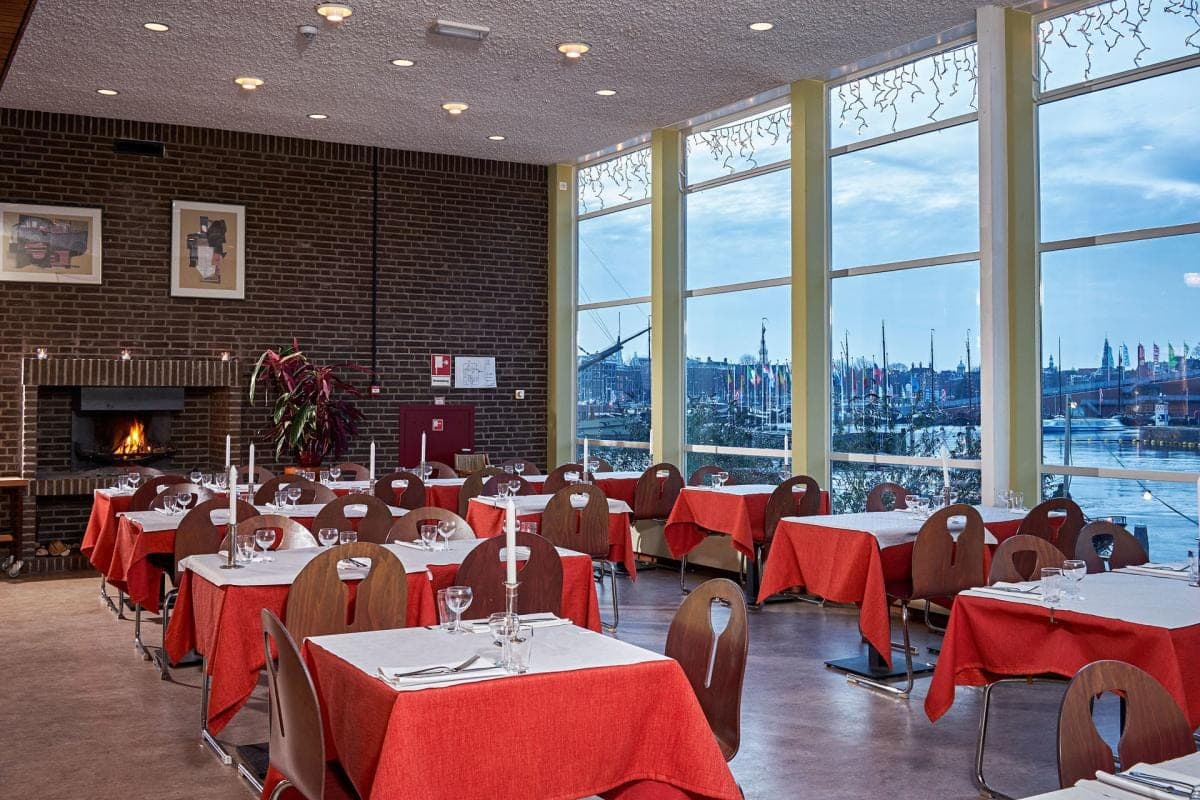
Foto: Pension Homeland
№ 35Marineterrein (Oostelijke Eilanden) · Dutch all-day kitchen, breakfast · €€7.6
Ontbijt vanaf 7:00 in de oude officiersmess op het Marineterrein, gegeten met het bestek van de mariniers zelf en uitzicht over het water.
Dit is de officiersmess van de voormalige marinewerf, omgebouwd tot hotel en restaurant, en het eten komt er nog steeds op het standaardbestek dat elke Nederlandse marinier ooit in handen kreeg. Dat detail zegt genoeg over de toon: zonder kapsones, een beetje institutioneel in de goede zin, en volstrekt onaangedaan. Het is het vroegste echt goede ontbijt van het centrum, alle dagen van de week open vanaf 7:00, waardoor dit een van de weinige Amsterdamse adressen is waar je een afspraak om half acht daadwerkelijk kunt inplannen. Binnen is het groot en hoog, met een open haard voor koude ochtenden en een terras aan het water voor die andere twaalf dagen per jaar, en op dat uur is het er zo goed als leeg. De keuken noemt zichzelf traditioneel, seizoensgebonden en huisgemaakt, en doet daar de eerlijke versie van: het Homeland-ontbijt is koffie, jus, croissant, toast, kaas, een gekookt ei en yoghurt met fruit en granola, met roerei met avocado en feta of gebakken eieren met ontbijtworstjes voor wie liever een bord dan een uitgebreide tafel heeft. Ze brouwen hun eigen bier op locatie, wat om acht uur 's ochtends niet de kern is maar wel laat zien dat ze het niet met de pet naar gooien. Kattenburg is lopen of kort fietsen vanaf Centraal, ver genoeg weg dat niemand er per ongeluk binnenvalt.
Bestel · Ontbijt dagelijks 7:00 tot 11:30, daarna vanaf 12:00 de vaste kaart. Gezelschappen van twaalf of meer krijgen een set menu en moeten vooraf mailen. Neem een tafel aan de waterkant, en reken op vijf minuten extra voor de wandeling over het Marineterrein.
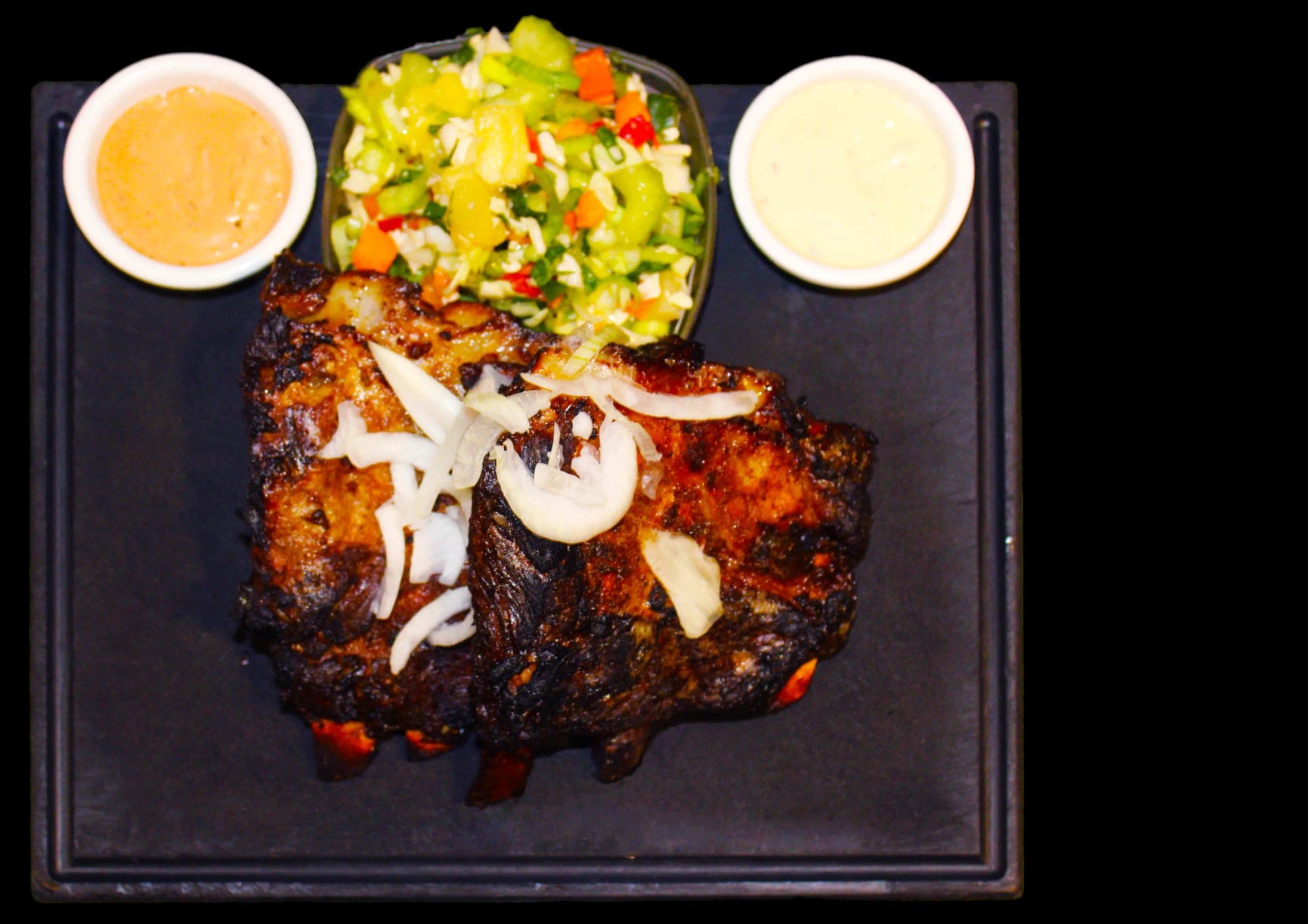
Foto: Café de Klos
№ 36Kerkstraat, Grachtengordel · Eetcafé, grill and spareribs · €€7.6
Sinds 1971 vlees voor de massa: spareribs van de houtskoolgrill, niet reserveren, geen uitzonderingen.
De Klos grilt sinds 1971 aan de Kerkstraat en de website zegt nog altijd wat het bord zegt: serving meat to the masses. Het is een klein donker café met een bar, een grill die je vanaf de Leidsestraat ruikt en een kaart die in decennia nauwelijks is verschoven. De klassieke spareribs komen als twee racks voor 24,70 euro met knoflooksaus, de gerookte versie voor 29,75, en daaromheen een entrecôte van 300 gram, een T-bone van 600 gram, een gerookte halve kip en een lamsschouder voor de hele tafel. De regel die de tent definieert is het deurbeleid: geen reserveringen, alleen inlopen, en als het vol is wacht je aan de overkant in het zustercafé met een biertje tot er een tafel vrijkomt. De spareribsgids van Your Little Black Book noemt de ribs waanzinnig, en de meeste Amsterdammers die hier opgroeiden zullen beamen dat dit de referentierib van de stad is, ook al is het er luid, staan de tafels dicht op elkaar en hebben de toeristen het gevonden. De prijzen zijn met het vlees meegekropen, en dit is een plek voor een groep met grote honger, niet voor een rustig etentje. Neem het geduld van de contantgeldtijd mee.
Bestel · Maandag tot en met donderdag open vanaf 16:00, vrijdag tot en met zondag vanaf 14:00, tot 23:00. Kom voor 18:00 of na 21:00 om het wachten te omzeilen; de zusterkroeg aan de overkant vangt je op. Bestel de klassieke ribs met knoflooksaus en deel een lamsschouder als je met z'n vieren bent.
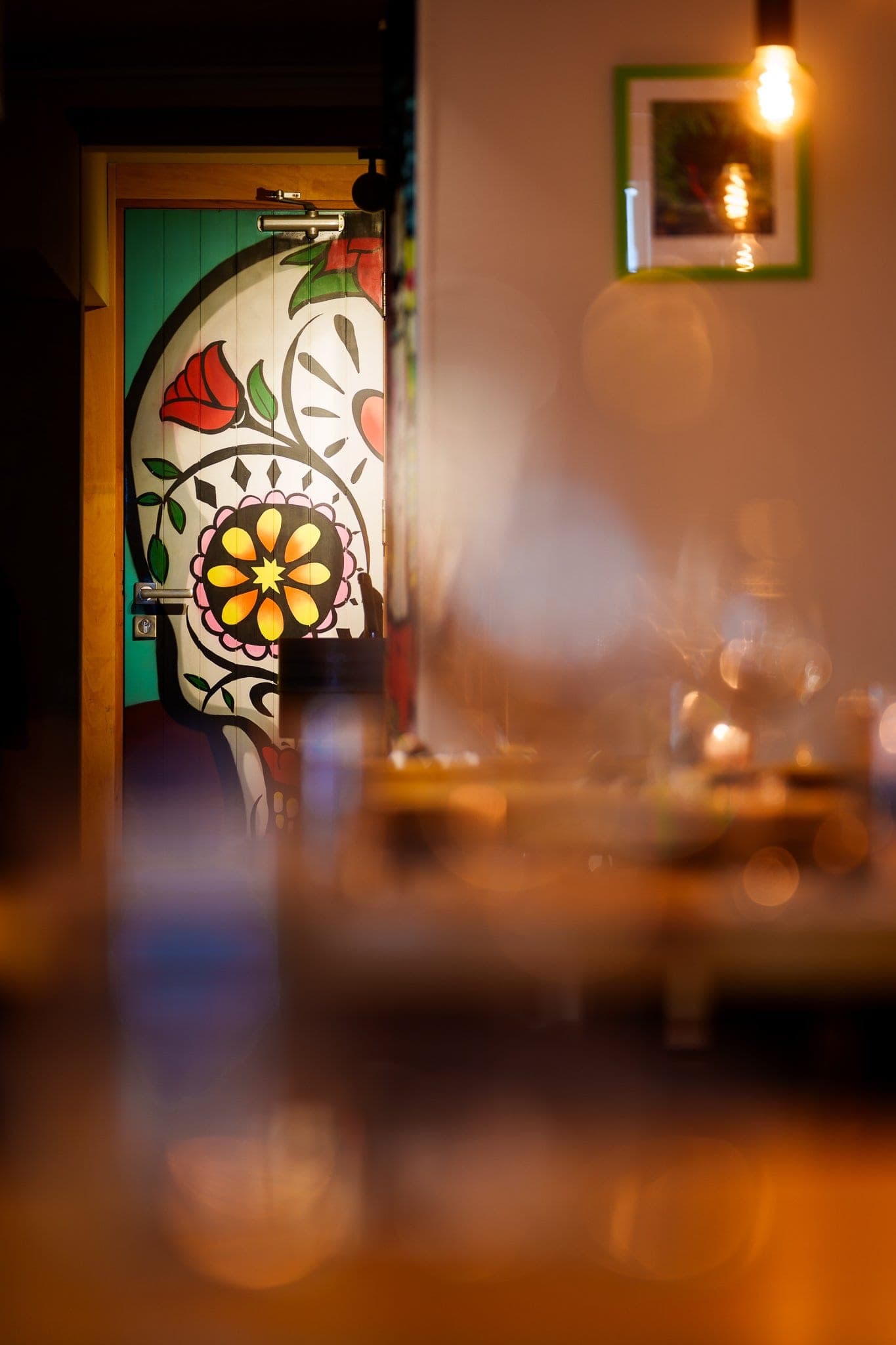
Foto: Copal, photo Studio Tentusscher
№ 37Grachtengordel · Modern Mexican · €€€7.6
Chef-eigenaar Miguel Martin Gomez herdoopte Colima eind 2025 tot Copal, een rokerige heropening op één straat van CUE.
Copal heette tot eind 2025 Colima, en Colima was naar het oordeel van de eigenaren zelf te veel een tacotent. Dus sloot chef-eigenaar Miguel Martin Gomez samen met zijn drie compagnons de deuren en opende weken later opnieuw, met een kaart gebouwd rond de hars waar de zaak naar vernoemd is, de wierook die Azteekse priesters als offer verbrandden. Het resultaat leest meer als fine dining dan als taqueria: wagyu-croquetas, tostada's van blauwvintonijn, driehonderdvijftig gram Holstein-ribeye afgemaakt met chimichurri en warme tortilla's, bbq-pulpo, huitlacoche in plaats van een veiliger groente. Drieënveertig mezcals en tequila's staan eronder, plus Mexicaanse whisky en cocktails met maislikeur. Twee chef-menu's geven de keuken het laatste woord, voor 42 of 55 euro per persoon. De zaak is nog geen jaar oud in deze vorm, na een Colima dat Het Parool prima kon waarderen, dus behandel het voorlopig als veelbelovend en net vernieuwd, niet als een vaste waarde met een decennium aan bewijs. Reserveren is verstandig, de tent is klein en er is alleen 's avonds open, dus geen vangnet voor wie zonder afspraak binnenloopt.
Bestel · Open woensdag t/m zaterdag 17:00-22:00 en zondag 17:00-21:30, maandag en dinsdag dicht; geen lunch, wat er ook op de site staat.
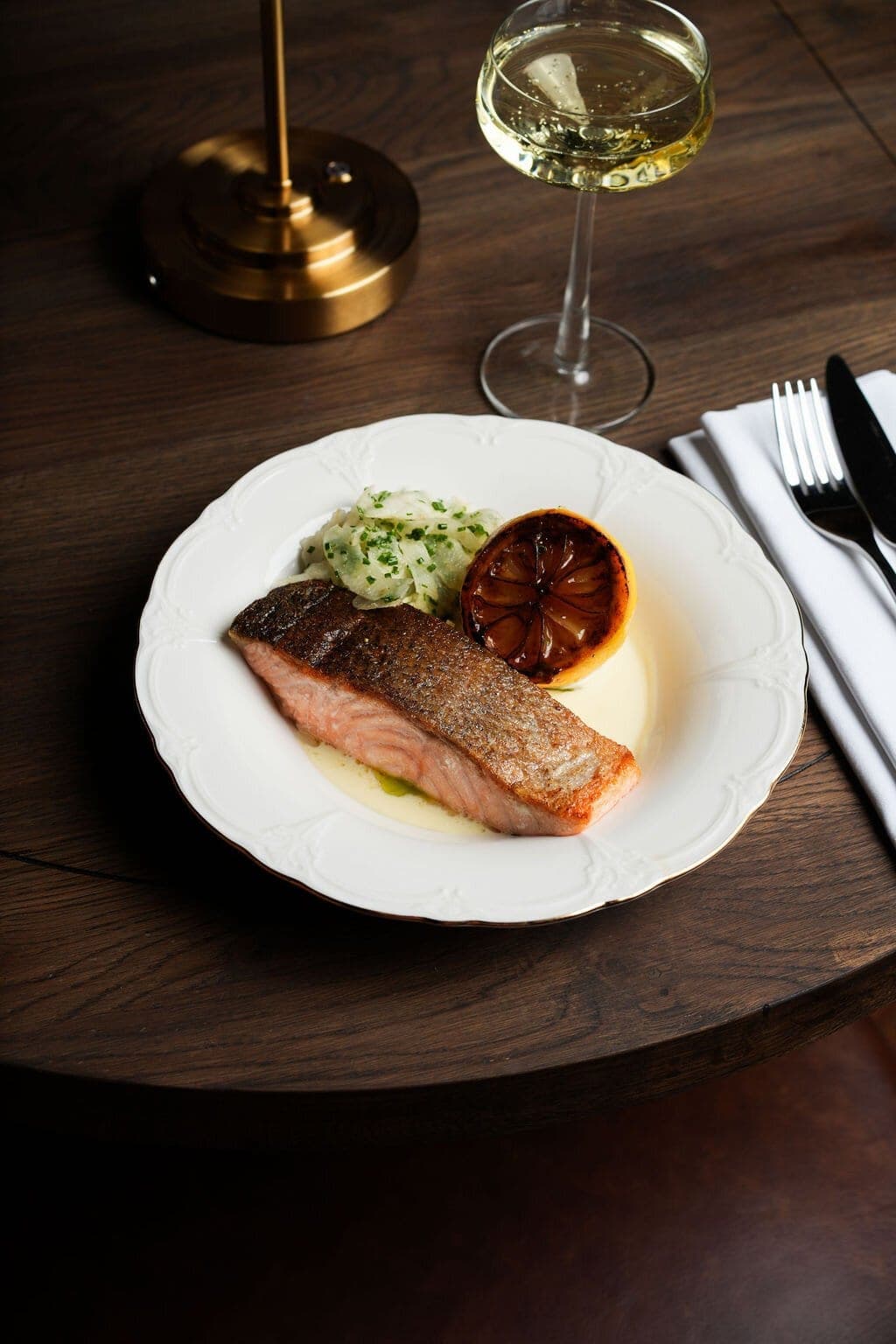
Foto: Chez van Rijn
№ 38Rembrandtplein · French brasserie · €€7.6
Parijse bistrobravoure in art-nouveaupand De Kroon; die zeldzame tafel aan het Rembrandtplein die Amsterdammers zelf boeken.
Het Rembrandtplein heeft decennia besteed aan het vervolmaken van de kunst toeristen van hun geld te scheiden, en juist daarom voelt Chez van Rijn bijna subversief. De familie Poppes, sinds de jaren negentig een begrip op het plein, sloopte hun oude Kitchen & Bar Van Rijn tot op het casco en heropende in februari 2026 in De Kroon, het monumentale hoekpand dat werd gebouwd voor de kroning van Wilhelmina, nu een en al kristallen kroonluchters, lampen met franje, wandtapijten en banken in ossenbloedrood. De keuken speelt de Franse bistrostandaards zonder kunstgrepen: oesters voor 4.50, oeuf mayonnaise voor 5.50, kippenleverpaté, escargots, moules frites in beurre blanc, en als signatuur de steak frites met entrecote en huissaus voor 24.50. De kroketten komen van Holtkamp, wat in Amsterdam geldt als een intentieverklaring. De uitgesproken missie is het plein teruggeven aan de Amsterdammers, en de zaak doet haar deel: dj's op vrijdag en zaterdag, iemand achter de vleugel op zondag, keuken open van lunch tot laat. De eerste recensies komen uit op hartelijke bediening en degelijk koken, niet op vuurwerk, en dat was precies de opdracht. Het beste Franse eten van de stad is dit niet; wel verreweg de beste reden om na zonsondergang op het Rembrandtplein te zijn.
Bestel · Ga op zondag voor de vleugel, of vroeg op vrijdag voordat de dj het overneemt; het oeuf mayonnaise van 5.50 is de slimste openingszet van het hele plein.
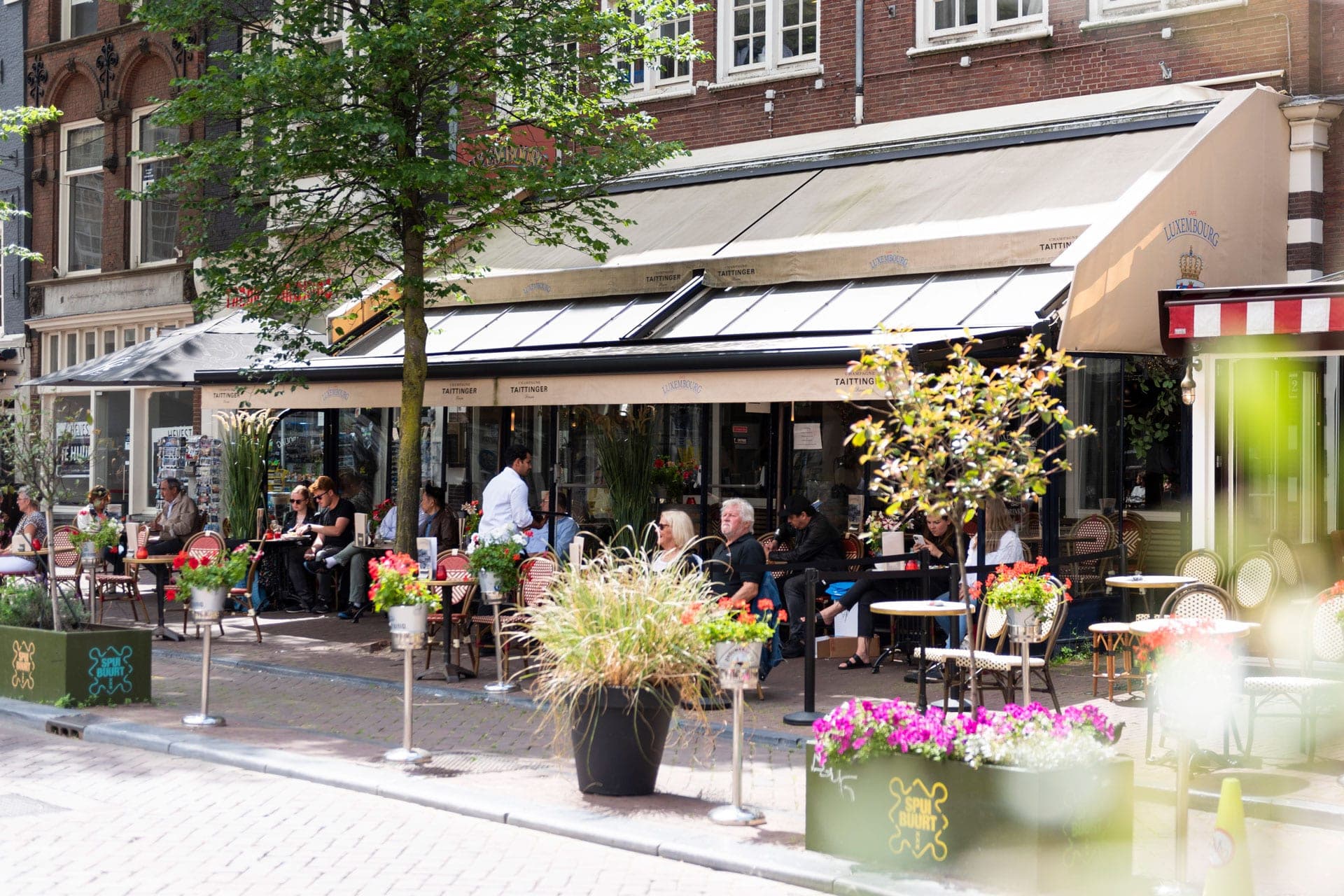
Foto: Café Luxembourg
№ 39Spui · Brasserie · €€7.5
Sinds de jaren tachtig het grand café van het Spui, en de thuisbasis van de Holtkamp-garnalenkroket.
Elke stad heeft één zaak nodig waar je om elf uur de krant leest, om één uur luncht en om zes uur nog steeds over politiek redetwist; in Amsterdam is dat sinds eind jaren tachtig Café Luxembourg. De marmeren tafeltjes en leesrekken doen aan Parijs denken, de keuken is Franse brasserie, bijgesteld op Hollandse eetlust. Maar de reden om de stad over te steken is de garnalencroquet van Patisserie Holtkamp: Luxembourg hielp hem ontwikkelen en bracht hem de Amsterdamse cafécultuur binnen, en hij is nog altijd de maatstaf. Smeuïge Noordzeegarnalen in een korstje dat knispert, mosterd ernaast, witbrood in een dienende rol. De bitterballen van Holtkamp liggen er ook, plus een jeneverkaart die opent met Bols en zijn papieren uit 1575. Het verwarmde terras kijkt over het Spui uit op Hoppe, open sinds 1670. Ga zitten, bestel, en kijk hoe de boekenmarkt voorbijkuiert.
Bestel · Twee garnalenkroketten van Holtkamp op witbrood met mosterd: de definitieve Spui-lunch.
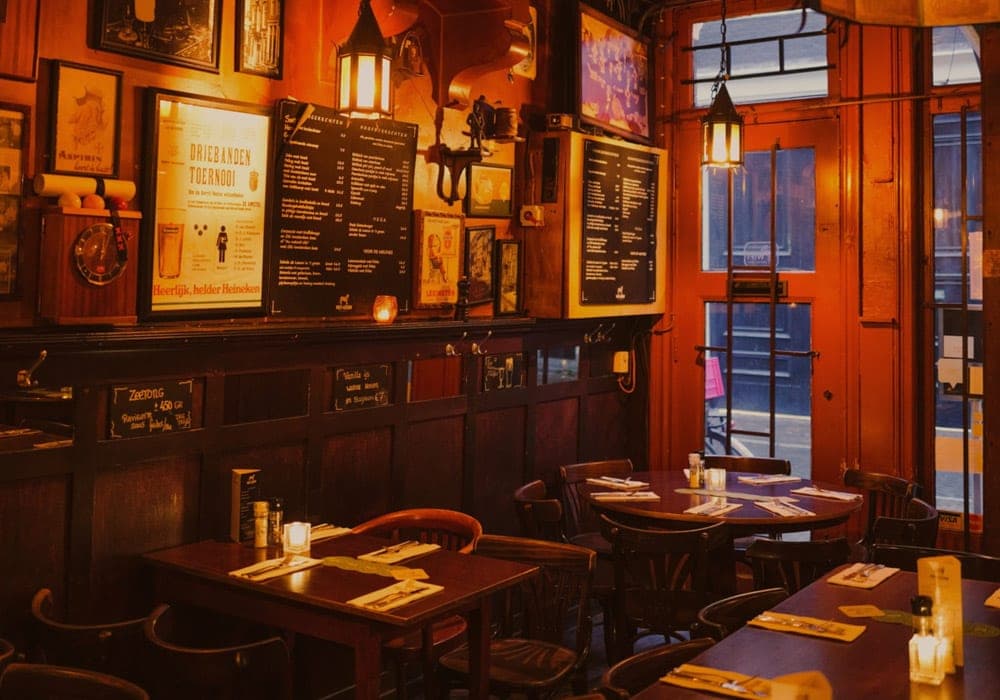
Foto: Steakhuis Piet de Leeuw
№ 40Weteringbuurt (Noorderstraat) · Dutch steakhouse, brown cafe · €€7.5
Sinds 1949 biefstuk in eigen jus met witbrood, in een bruin café dat elke voedseltrend twee keer heeft overleefd.
Er zijn oudere restaurants in Amsterdam, maar weinig waar de tijd zo aangenaam heeft stilgestaan. Sinds 1949 schuift de stad hier aan voor biefstuk zonder ceremonie: donker hout, jeneverkruiken, schoolborden en olieverf aan de muur, en op tafel een ossenhaas in eigen jus met witbrood om te soppen. Gebakken uien erbij, uiteraard, voor 3,50. De kaart is in de loop der jaren gegroeid, met ribeye, carpaccio en zelfs paling op toast, maar bij een eerste bezoek iets anders bestellen dan biefstuk is stoerdoenerij. Over het paard: ooit was er een relletje omdat paardenvlees stilletjes als rund werd geserveerd, nu staat de paardenhaas gewoon eerlijk op de kaart, en hij is, fluister het, voortreffelijk. Hoofdgerechten blijven onder de 33 euro, de obers hebben de timing van mensen die dit al decennia doen, en het onopvallende zijstraatje bij de Vijzelgracht houdt de toeristen keurig op afstand.
Bestel · Kom doordeweeks tussen 12:00 en 17:00, dan draait de volledige kaart en is er altijd wel een tafel; de gebakken uien voor 3,50 zijn geen optie maar een plicht.
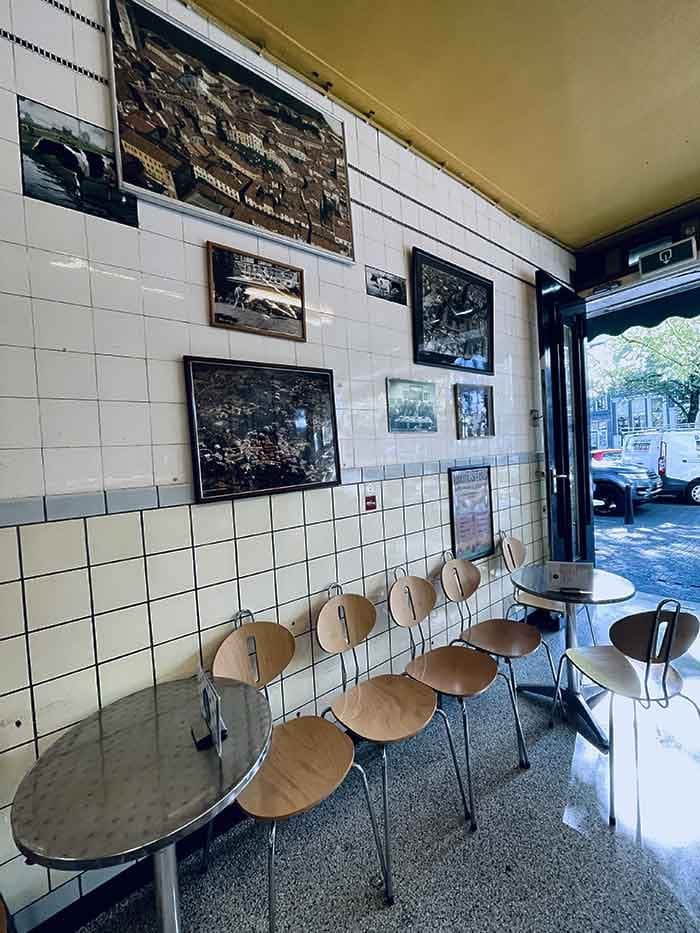
Foto: Amsterdam Walks
№ 41Nieuwmarkt · Gelato · €7.5
Het Italiaanse zomerhoekje van de Nieuwmarkt, schept al sinds 1942 aan deze gracht.
De broers Michele en Antonio Tofani vertrokken in 1920 uit het Toscaanse dorp Benabbio om gipsen heiligenbeelden te verkopen, ontdekten dat Amsterdammers liever ijs hadden dan religie, en openden in 1939 hun eerste salon. Het filiaal aan de Kloveniersburgwal volgde in 1942 en is nooit meer verhuisd. Sinds 2003 is de zaak van Riccardo en Daniele Politi, ook uit Benabbio, die het vak bij de familie Tofani leerden voordat ze het overnamen; ordelijker worden opvolgingen in dit vak niet. Het ritme is strikt Italiaans: open van ongeveer april tot oktober, dan gaan de luiken dicht en gaat iedereen naar huis voor de winter. In het seizoen krijg je echte gelato, echte espresso, cannoli en een grachtterras waar half de Nieuwmarkt zijn middagen slijt. Voor de bolletjes mojito en pistache steken mensen de brug over. Een toonbank met terras voor overdag en de avond, geen dineradres, en in januari helemaal geen adres.
Bestel · Bestel op een hete dag de caffè shakerato met een bolletje erbij, en onthoud het seizoen: in de winter zijn ze volledig dicht, dus check het voor je van november tot maart de stad doorfietst.
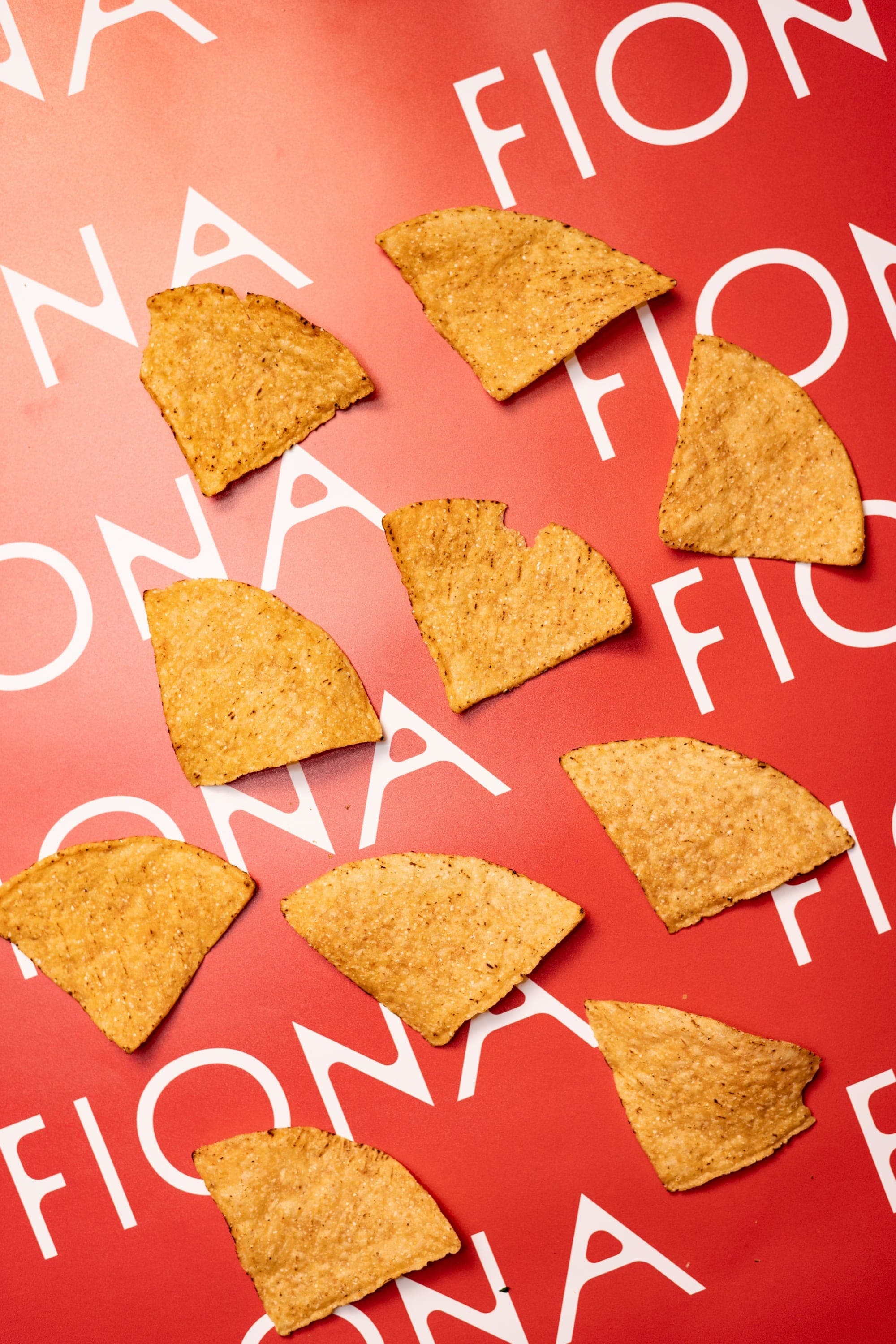
Foto: Fiona
№ 42Wallen · Mexican · €€€7.5
De kaart is ontworpen door tv-chef Zahie Tellez, maar wie er avond na avond kookt is Jef van Hout, ex-Bord'Eau en ex-Le Restaurant.
Fiona zit onder een hostel aan de Warmoesstraat, wat niets zegt over wat er in de keuken gebeurt. De kaart is ontworpen door Zahie Tellez, de Mexicaanse tv-chef en kookboekauteur, maar zij staat zelf niet achter het fornuis: de dagelijkse dienst is in handen van chef Jef van Hout, die zijn sporen verdiende bij Bord'Eau en Le Restaurant voordat hij zijn eigen zaak The French Connection runde. Dat onderscheid maakt Fiona zelf ook duidelijk, in plaats van alleen op Tellez' naam te leunen. Het eten is klassiek: tonijnceviche in leche de tigre, langzaam gegaarde octopus met wasabimayonaise, spareribs, een echte chile en nogada als het seizoen het toelaat, taco's en quesadilla's voor wie het rustiger aan wil doen. De ruimte, ergens tussen Tulum en Mexico-Stad, wordt na het donker luid en de cocktailbar loopt na het diner gewoon door. Het is een grote, marktgeteste zaak, met ruim duizend beoordelingen en tellend, meer publiekstrekker dan persoonlijk statement, maar de keuken levert wat ze belooft.
Bestel · Keuken open ma-do 17:00-00:00, weekend vanaf 12:30. Taco Tuesday is twee taco's en een cocktail voor €24; de Sunday Club, elke tweede zondag van de maand, is een driegangenmenu van €35 met een bevroren margarita.
№ 43Nieuwmarkt · Eetcafé, Mediterranean-Dutch · €7.4
Het derde bruine café van de ploeg achter De Reiger, in het voorjaar van 2026 heropend met drie gangen voor zo'n 30 euro en een verborgen binnentuin.
Van Beeren is vernoemd naar Gerrit van Beeren, de groenteboer wiens winkel vanaf 1936 op deze hoek van de Koningsstraat stond, en decennialang was het het kraker-en-studenteneetcafé van de Nieuwmarkt met een binnentuin waar niemand op rekende. In het voorjaar van 2026 ging het over naar Xander Waller, Jasper Gottlieb, Wout Meulemans en Fons Lagendijk, het team achter Proeflokaal De Druif en het heropende Café de Reiger, met Xavier Berben als vijfde partner, en het ging weer open met een verbouwd maar herkenbaar interieur: houten lambrisering, kaarslicht op tafel, plek aan de bar, de tuin intact en bediend tot 22:00. De kaart is bewust kort en mediterraan: sardine-escabeche voor 10 euro, linzensoep voor 6,50, melanzane voor 14, merguez voor 15, een lamsbrochette voor 18, een halve kip voor 19,50, een entrecôte van de plancha voor 26 en een vis van de dag voor 23, zodat drie gangen zoals beloofd rond de 30 euro uitkomen. AmsterdamNow schreef in april 2026 over de heropening en de openingslijst 2026 van Broersma pikte het eruit om de betaalbaarheid. Voor een vast oordeel is het te nieuw, maar de stamboom is op dit moment de beste in de bruinecafébranche en de binnentuin alleen al is de omweg vanaf de terrassen op de Nieuwmarkt waard.
Bestel · Dagelijks open 16:00 tot 01:00, keuken vanaf 17:00, binnentuin tot 22:00. Een deel van de tafels blijft altijd vrij voor inlopers; vroeg of laat komen levert je de bar op. Bestel de escabeche, de merguez en de vis die er die dag is.
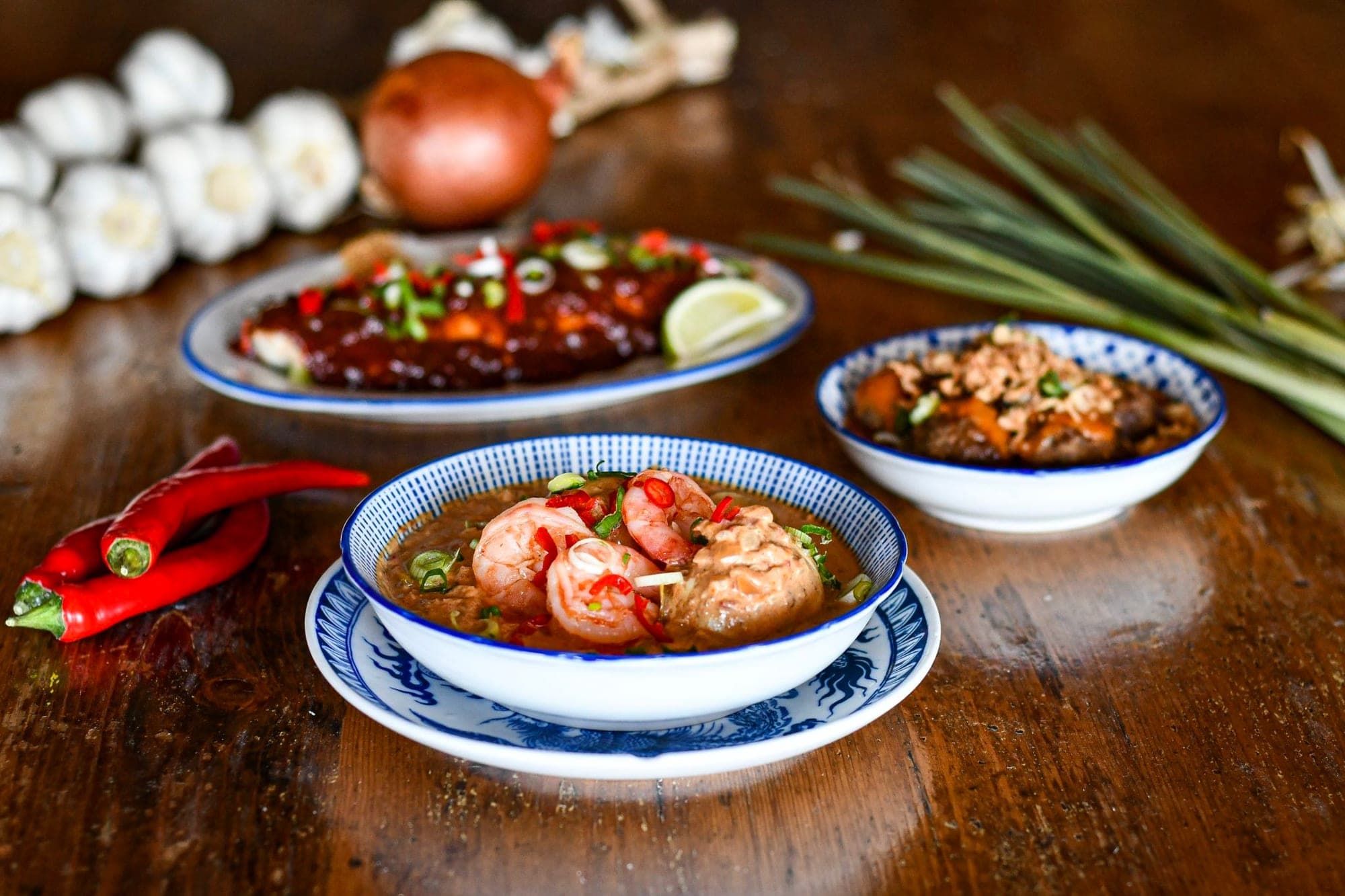
Foto: Café Kadijk
№ 44Kadijken · Eetcafé, Indonesian · €€7.4
Het Indisch bordje op een hoek uit 1727 bij het Entrepotdok: een familie-eetcafé waar de rijsttafel als één bord komt.
Kadijksplein 5 is een huis uit 1727 dat Stadsherstel in 1997 restaureerde, in de jaren zestig berucht als Café Confianza, en nu al zo'n twintig jaar Café Kadijk, een familiecafé waarvan de keuken Indonesische familierecepten kookt. Het idee is dat je voor een drankje komt en blijft eten: het Indisch bordje van 25,50 euro zet rendang Padang, smoor daging, ayam boemboe Bali, gado gado, rijst, kroepoek en atjar op één bord, een rijsttafel zonder de ceremonie, en daaromheen staan Indische makreel in een hete saus, lamsgulai, saté ayam en eitjes à la tante Bea. De Parool-recensie van Johannes van Dam, jaren geleden, is wat de tent voor het eerst vol kreeg, en vol bleef het; de test van Tip de Toko in 2024 gaf een 7,5 en merkte op dat het op een woensdag bomvol zat met snelle doorloop. Geen reserveringen, een caféachtig interieur met een bar, en een groot terras plus een overdekt verwarmd terras op het plein, op een zomeravond een van de fijnere plekken om te zitten in het oostelijke centrum. Twee eerlijke voorbehouden: de smaken zijn zachter dan een tokopurist wil, en de site zegt zelf dat de basis elke ochtend in een keuken in Noord wordt bereid en 's avonds ter plekke wordt afgemaakt, dus dit is een familiale productiekeuken, geen wok achter de bar.
Bestel · Dagelijks open 17:00 tot 01:00, geen reserveringen, dus kom doordeweeks voor 19:00 of reken op even wachten aan de bar. Bestel het Indisch bordje en een saté ayam om te delen, met een Bintang.
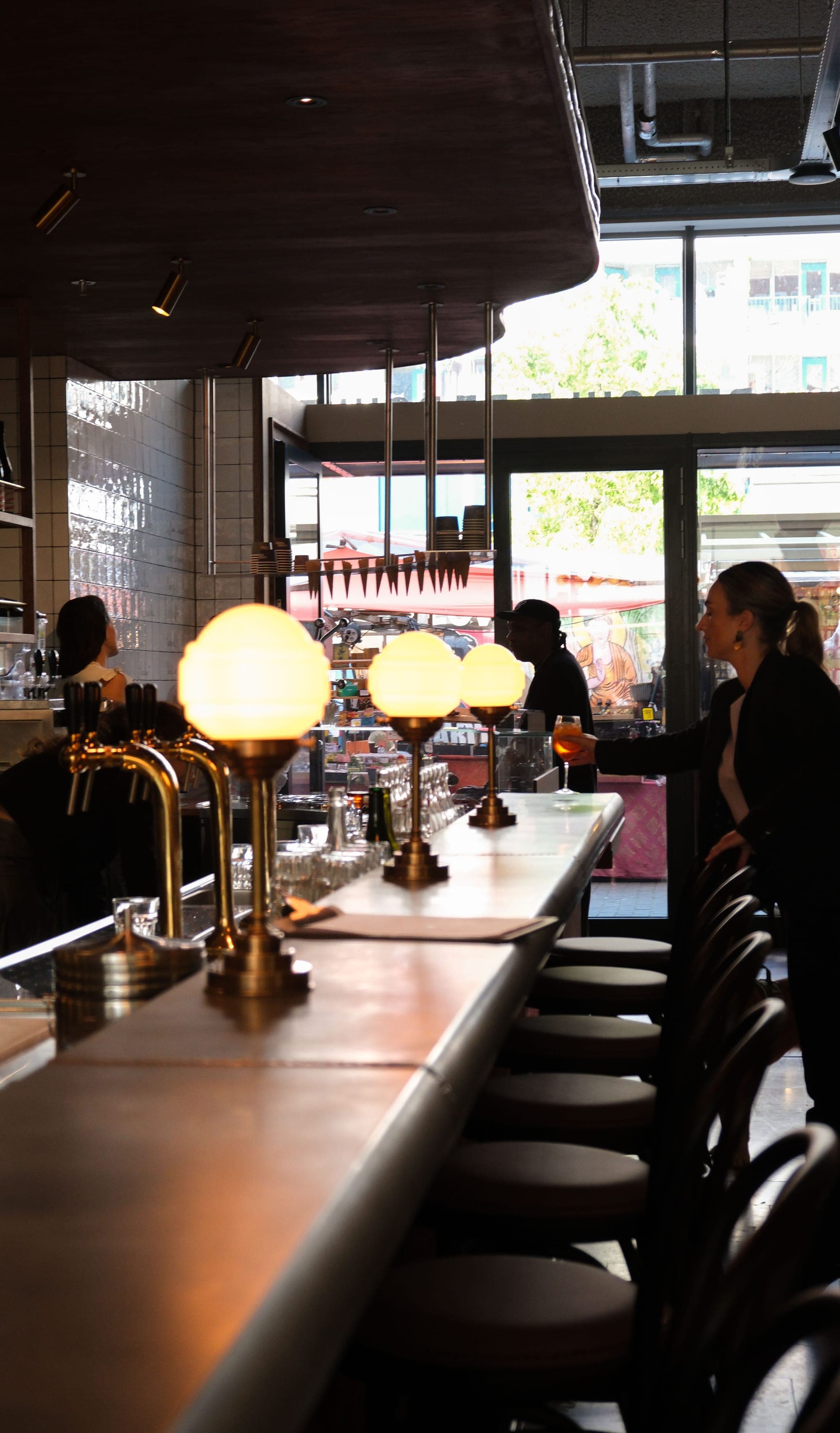
Foto: De Boule De Boule
№ 45Waterlooplein · Ice cream · €7.4
De eerste ijs- en wijnsalon van het land, waar natuurwijn naast plantaardige boules staat bij de Stopera.
De Boule De Boule, in juni 2026 geopend door horecaondernemer Kirsi Rautiainen en sommelier Dominique, is de eerste ijs- en wijnsalon van Nederland, en dat klinkt als een gimmick tot je er zit. Twee patissiers draaien een dozijn volledig plantaardige smaken in eigen huis, en de combinaties lezen als iemand die er plezier in heeft: saffraan met sinaasappel, olijfolie met basilicum, kokos met limoen. De wijnkaart is biologisch en natuurlijk met serieuze alcoholvrije opties, het pand aan de Stopera heeft een lange bar, een loungehoek en een overdekt terras, en vinyl of een dj draagt het geluid van de middag de avond in. De stelling is dat ijs een plek in de horeca verdient voorbij het schouderophalen na het diner, en de vakpers hapte gretig: RestaurantKrant, Misset Horeca en Talkies schreven allemaal over de opening. Te nieuw voor instituutsstatus, dus zo gescoord, maar het vakwerk is echt. Op zondag dicht, gek genoeg.
Bestel · Ga voor de pairing: een boule olijfolie-basilicum naast een glas natuurwitte wijn is de bestelling die het hele concept uitlegt. Doordeweekse middagen zijn het rustigst.
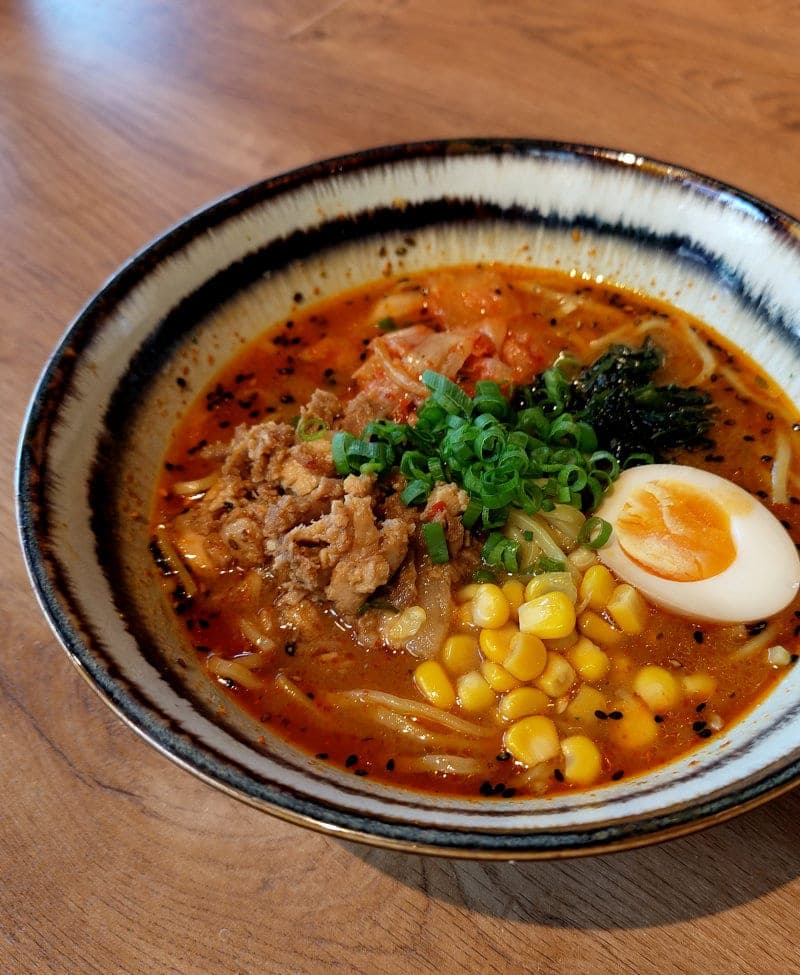
Foto: Taka Ramen
№ 46Nieuwmarkt · Ramen, Japanese street food · €€7.4
Taka leerde het vak drie jaar in Tokio en schept alleen tussen twaalf en vier, op de bovenste verdieping van Toko Dun Yong.
Taka kwam in 2008 voor een kantoorbaan naar Nederland, vond de ramen hier onder de maat en vertrok terug naar Tokio om drie jaar in de leer te gaan. Sinds 2012 verkoopt hij zijn kommen in Amsterdam, eerst vanaf een kraam op het Waterlooplein, daarna een tijd op de bovenste verdieping van Toko Dun Yong, toen een tussenstop in de Jordaan, en uiteindelijk voorgoed terug naar diezelfde verdieping aan de Stormsteeg: je klimt langs servies en keukenspullen naar een kale ruimte met uitzicht op de Geldersekade. De kaart is kort en alleen overdag: shouyu, miso en een stevig pittige tantanmen van €16,95, een halal kipkom, een kom met zeevruchten, en Japans straatvoer ernaast, van torigyoza tot takoyaki. Hij maakt alles zelf, volgens zijn eigen regels en die van niemand anders, en precies dat proef je. De specials wisselen, en er duikt geregeld een tsukemen op met een dipbouillon van vis, varken en kip; vragen loont. Fou Fow Ramen zat hier trouwens al eerder, van 2011 tot 2014, met een eigen pop-up boven diezelfde toko voordat die zaak naar de Elandsgracht verhuisde; Taka's tijd hier is een los, later verhaal, onafhankelijk daarvan. Your Little Black Book noemde Taka misschien wel de beste ramenchef van het land. Zo ver gaan wij niet, maar voor deze prijzen, met dit uitzicht, is de rij op zaterdag goed te verklaren. Er is een tweede vestiging bij het Gelderlandplein; deze verdieping is het origineel.
Bestel · Dagelijks 12:00-16:00, alleen lunch, reserveren kan niet. Kom doordeweeks voor 13:00, anders zit het er vol; de torigyoza van €7,50 houd je voor jezelf, en vraag naar de tsukemen-special voordat je een kom kiest.
№ 47Grimburgwal, Oude Zijde · Eetcafé, Dutch · €7.2
Een bruin café uit 1977 achter de universiteit, met een terras aan het water en een dagschotel die nog onder de tien euro begint.
't Gasthuys zit sinds 1977 aan de Grimburgwal, ingeklemd tussen de oude universiteitsgebouwen en de Oudezijds Achterburgwal, en het is het laatste eerlijke eetcafé in een hoek van het centrum die zich verder aan de wafels heeft overgegeven. Donkere houten lambrisering, een bar waar de stamgasten tegenaan hangen, en een klein terras boven het water dat de middagzon vangt. De keuken is pretentieloos in de oorspronkelijke zin: een huisgemaakte Gasthuys burger en een vegetarische voor 14,50 euro, huisgemaakte kipsaté voor 16,50, spareribs met whisky- en knoflooksaus voor 17,50, een biefstuk met kruidenboter voor 18, alles met friet en salade, en een dagschotel op het krijtbord die de budgetlijst van Barts Boekje klokt vanaf 9,75 euro, en zo eten studenten hier nog altijd. De lijst met bruine cafés van Your Little Black Book uit september 2024 pikte het er precies daarom uit: een dagschotel of iets uit de frituur met een biertje aan de gracht. De keuken draait doordeweeks tot 21:00 en op vrijdag en zaterdag tot 21:30, dus dit is een vroeg diner, geen laat. Het verandert niemands leven, en de toeristenstroom over de Grimburgwal is 's zomers onophoudelijk, maar als plek om voor minder dan twintig euro een fatsoenlijk bord te eten in het hart van de oude stad is het zo goed als uniek.
Bestel · Dagelijks open vanaf twaalf uur; keuken tot ongeveer 21:00, op vrijdag en zaterdag 21:30. Doordeweeks hoef je niet te reserveren. Kijk eerst op het bord voor de dagschotel, dan de saté; neem het terras boven het water als het vrij is.